
Loog Piano Review 2026: Great for Kids, Wrong for Adults
It sounds good, it survives a playroom, and children play it without being asked. The keys are also 21% narrower than a real piano's. Who that suits, and who it doesn't.
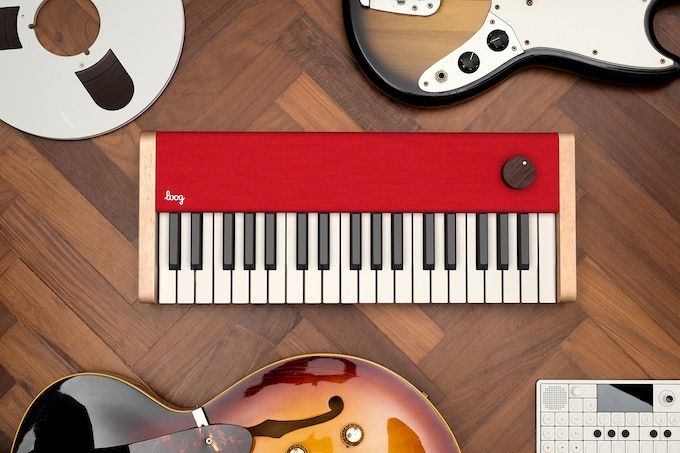
The Loog Piano is a $249, 37-key digital piano built for children aged 3 to 8. It sounds good, it survives a playroom, and the app and flashcards get a young child playing in an afternoon. Its keys are 21% narrower than a real piano's, which is the fact that decides whether you should buy one.
Buy it for a small child who needs a first instrument they'll enjoy. Skip it for an adult beginner, for a teenager, or for any child who already takes lessons. Those buyers want full-size keys, and a 61-key keyboard in the same price range gives them that.
Loog Piano review scores
Last checked September 2026A three-year-old can switch it on and play something alone.
Narrow keys and three octaves cap what transfers to a real piano.
One knob, one sound, no menus.
Fair for what it is. A 61-key rival buys more instrument.
Scored as a first instrument for a young child, which is what Loog built it to be.
Specifications
| Price | $249 (list $299) |
| Keys | 37 (3 octaves), velocity sensitive |
| Key width | 0.73 in / 18.5 mm white keys |
| Key material | ABS plastic |
| Action | Synth action, not weighted |
| Sounds | One piano voice |
| Speakers | Built-in stereo |
| Battery | 3000 mAh, up to 8 hours |
| Connectivity | USB-C (MIDI and charging), MIDI over Bluetooth |
| Jacks | 3.5 mm headphones, sustain pedal, octave shifter |
| Size | 18.92 × 7.5 × 2.71 in (480.8 × 190.5 × 68.9 mm) |
| Weight | 3.64 lb (1.65 kg) |
| Materials | Solid wood side panels, polyester fabric top |
| In the box | Piano, chord and scale flashcards, printed guide, USB-C cable |
| Age range | Manufacturer says 3 and up |
The key width is the whole review
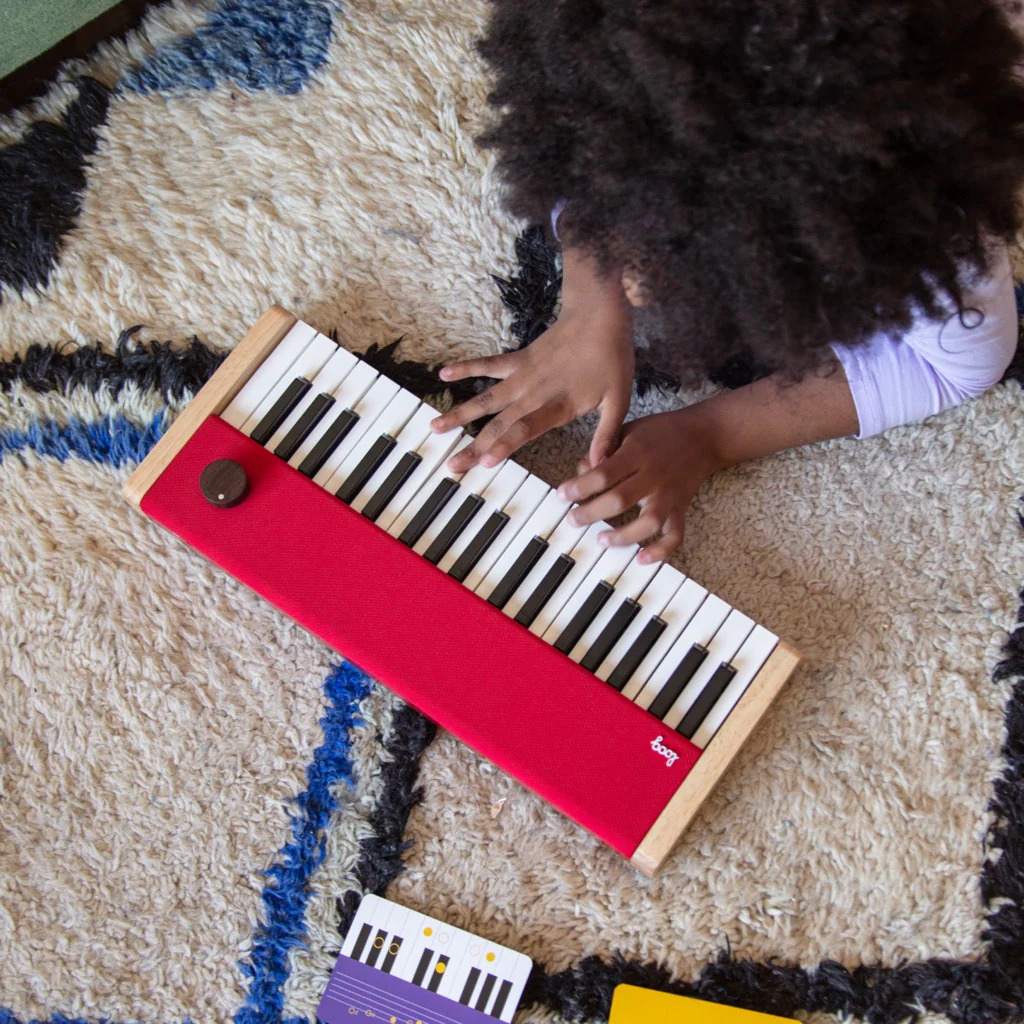
Loog's white keys measure 18.5 mm across. An acoustic piano's measure about 23.5 mm. Every review of this instrument should lead with that number, and almost none of them mention it.
The difference compounds across the keyboard:
| Loog Piano | Standard piano | |
|---|---|---|
| White key width | 18.5 mm | 23.5 mm |
| One octave (7 white keys) | 129.5 mm | 164.5 mm |
| Full keyboard span | 480 mm (37 keys) | about 1,225 mm (88 keys) |
A child who can stretch an octave on a Loog has to reach 27% further to do the same thing on a real piano. Hand span is the limit that decides when a young player can start playing octaves and full chords, so a narrow keyboard changes what they're learning. The notes transfer. The distances don't.
For a five-year-old, that trade is worth making. Their hands can't span a standard octave anyway, and narrow keys let them play chord shapes years earlier than they otherwise could. For a nine-year-old, or anyone older, it works against them: they build muscle memory at one scale and have to rebuild it at another.
That single fact explains the review scores below. Fun: high. Actual learning: middling.
Sound and playing feel
Loog made an unusual choice for a kids' keyboard: one piano sound, and no drum kits, no strings, no demo songs. A child who sits down can only make piano noises, which keeps the instrument pointed at learning rather than at button-pressing.
The sound itself is good for the size. The stereo speakers fill a bedroom, and the velocity-sensitive keys respond to how hard they're struck, so a child hears the difference between soft and loud from the first session. That responsiveness matters more for early learning than most spec-sheet features, because dynamics are where playing starts to feel like music.
The action is synth-style rather than weighted, which is standard at this price and this size. The keys are ABS plastic with a 9 mm keyboard depth. One independent reviewer who bought a unit called the plastic "pretty atrocious" and the keys "almost unplayably cramped" for adult hands. Adult hands are not the target, and that assessment lines up with the key width: this is a child's instrument, and it feels like one under a grown-up's fingers.
The app, the flashcards, and the Duolingo version
The Loog Piano app has now launched. It runs video lessons, a chord section, game-style exercises, and play-along songs, and it connects to the piano over Bluetooth MIDI so it can hear what's being played and respond.
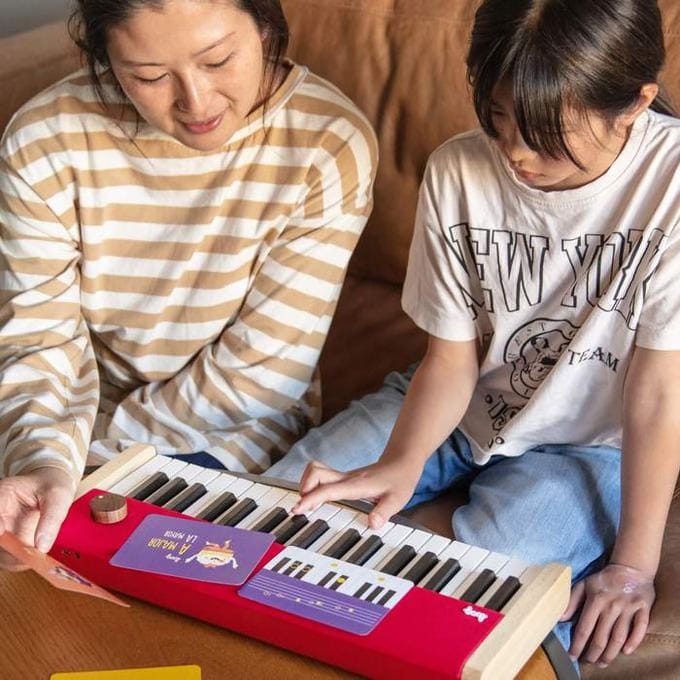
The flashcards in the box cover chords and scales with no screen involved, which is the part parents tend to appreciate most. Alternating between cards and app keeps a young child's attention longer than either does alone.
There's also a Loog x Duolingo Piano, same $249, which swaps the standard flashcards for Duolingo-branded ones and adds a wooden phone stand. It's built to pair with Duolingo's music course, which teaches sight reading and ear training and licenses more than 60 recordings from Sony Music, including tracks by Whitney Houston, Hozier, and Pharrell Williams.
Picking between them comes down to whether your child already uses Duolingo. The hardware is the same.
What 37 keys can and can't do
Three octaves covers most beginner repertoire and almost all single-line melodies. The octave shifter accessory moves the range up or down, which extends what's reachable without adding keys.
It can't handle two-handed playing with any spread. Classical writing puts the left hand two octaves below the right as a matter of course, and on 37 keys the hands run into each other. A child will hit this ceiling around the time they start playing pieces with a real bass line, which for a motivated learner is somewhere in year one or two.
Plan on this being an instrument they outgrow rather than one they keep.
Build quality, and the Kickstarter history
The wood side panels and fabric top look better than anything else at this price, and the single volume knob means a three-year-old can operate it alone. The design has won recognition, including a 2024 Good Design Award from the Chicago Athenaeum Museum of Architecture and Design.
The launch was rough, and buyers should know it. The Loog Piano shipped through Kickstarter more than six months behind schedule, with specifications that changed during the campaign. At least one reviewer received a unit that wouldn't power on, and reported that the volume potentiometer is soldered to the board without support, and that fitting the optional legs means removing the rubber feet for good.
Retail units have been shipping for a while now and those complaints have faded from recent feedback. Buy from a seller with a clean return process anyway, and test everything in the first week.
How it compares
| Instrument | Keys | Key width | Action | Best for |
|---|---|---|---|---|
| Loog Piano | 37 | Narrow (18.5 mm) | Synth, velocity sensitive | Children 3-8, first instrument |
| Casio Casiotone CT-S1 | 61 | Full size | Synth with a semi-weighted feel | A first keyboard that lasts past year two |
| Yamaha Piaggero NP-12 | 61 | Full size | Piano-style, touch sensitive | Learners heading toward real repertoire |
| Any 88-key weighted digital | 88 | Full size | Hammer action | Anyone serious about learning piano |
Prices move, so check our guide to the best beginner pianos for what these cost now. The short version: for the price of a Loog, an adult beginner can buy a 61-key instrument with full-size keys, and they should.
Who should buy the Loog Piano
Buy it if:
- Your child is between about 3 and 8 and has never played anything
- You want an instrument that looks good enough to leave out in the living room
- Screen-free practice matters to you, and the flashcards appeal
- You want a real instrument rather than a toy keyboard, at toy-keyboard scale
Skip it if:
- You're an adult beginner, whatever the marketing says
- Your child is nine or older, or already takes lessons
- You want one instrument that lasts years rather than one that gets outgrown
- You need more than a piano sound
Frequently asked questions
How much does the Loog Piano cost?
The Loog Piano costs $249, down from a $299 list price. The Loog x Duolingo Piano is the same $249 and includes Duolingo flashcards and a wooden phone stand instead of the standard accessories. Bundles with a stand, case, or legs cost extra and come and go from stock.
Are the Loog Piano keys full size?
No. Loog's white keys are 0.73 inches (18.5 mm) wide, against about 0.93 inches (23.5 mm) on a standard piano, which makes them 21% narrower. That suits small hands and is the main reason the instrument suits young children rather than adults.
Is the Loog Piano good for adult beginners?
No. The keys are too narrow and too few for adult hands, and one reviewer described them as almost unplayably cramped. An adult beginner gets far more from a 61-key keyboard with full-size keys at a similar price.
How many keys does the Loog Piano have?
37 keys, which is three octaves. That covers most beginner melodies, and the optional octave shifter moves the range up or down. It runs out when a piece needs the hands spread far apart.
Are the Loog Piano keys weighted?
No. They are synth-action and velocity sensitive, so they respond to how hard you play but have no hammer weight. Weighted actions start on larger, heavier instruments.
Does the Loog Piano need the app?
No. The flashcards in the box teach chords and scales with no screen. The app adds video lessons, exercises, and play-along songs, and connects over Bluetooth MIDI so it can respond to what your child plays.
What age is the Loog Piano for?
Loog says 3 and up. In practice it fits children from about 3 to 8. Past that, hands grow into full-size keys and three octaves starts to limit what they can play.
Can you connect the Loog Piano to a computer?
Yes. It sends MIDI over USB-C and over Bluetooth, so it works as a controller for any music software. It also takes a sustain pedal and has a 3.5 mm headphone jack for silent practice.
How long does the Loog Piano battery last?
Up to 8 hours from its 3000 mAh battery, charged over USB-C. That is enough for several weeks of a young child's practice between charges.
Is the Loog Piano worth it?
For a child aged 3 to 8, yes. You are paying a premium over a plastic keyboard for real wood, a good piano sound, velocity-sensitive keys, and a learning system that works. For anyone older, the same money buys a more useful instrument elsewhere.
The verdict
The Loog Piano is the nicest first instrument you can put in front of a small child, and it is the wrong purchase for everyone else. Loog built it for short fingers and short attention spans, and on those terms it succeeds: it looks good, it sounds good, it survives being left out, and children play it without being asked.
The narrow keys buy that success and set the limit on it. A young child gains years of playing they couldn't otherwise have. An older one starts building habits at the wrong scale.
If your child is three and curious, this is money well spent. If your child is nine, or the beginner is you, spend it on something with full-size keys.
Comments ()