
Simply Piano Review: Is This $170/Year App Worth It?
Let’s cut the crap: learning piano is hard. Like, really hard. It’s one of those things that looks easy until you sit down at the keys and realize your fingers are all thumbs and your rhythm is straight-up tragic.
So when an app comes along promising to make it “fun and easy” to play piano from your couch, you’ve got to ask… really?
I’ve been playing for years, and teaching too. So I downloaded Simply Piano with an open mind, but also a raised eyebrow.
Let’s talk about what actually works… and what kind of nonsense this app tries to pull.
TL:DR
- Simply Piano is a polished, gamified app that can get a total beginner playing basic songs, but it stalls out at early-intermediate level, gives shallow feedback, and costs $169.90/year for what amounts to a foundation course.
- Best for: Kids and casual dabblers who need motivation more than instruction.
- Skip it if: You're an adult who's serious about actually playing. A one-time-payment course like Pianoforall will take you further, for less money, without a subscription hanging over your head.
- Rating: 3.5/5 — good app, questionable value.
- Pricing: $17.90/month or $169.90/year (Individual); $23.90/month or $209.90/year (Family, up to 5 profiles across all Simply apps). 14-day free trial on annual plans.
- The catch: No technique feedback, no eyes on your hands, simplified song arrangements, and a ceiling you'll hit within a year or two.
Note: Simply Piano is currently ranked #2 on our list of the Best Online Piano Lessons. It’s a fun and beginner-friendly app, but not without its drawbacks. Scroll down for the full, no-BS review.
What is Simply Piano?
Simply Piano comes from Simply (the company formerly known as JoyTunes), which also makes apps for guitar, singing, and drawing. The pitch is familiar by now: skip the boring lessons, open the app, play your favorite songs by tonight.
You run it on a phone or tablet, play on a real keyboard or piano, and the app listens through your device's microphone to judge whether you hit the right notes at the right time.
The lessons were built by music teachers, the underlying tech is patent-protected, and the curriculum is accredited by Trinity College London. That all sounds impressive on paper.
In practice? It's a note-checker with nice production values. Useful, but let's not confuse it with teaching.
Is Simply Piano Actually Good?
Credit where it's due: the onboarding is genuinely well done. The interface is clean, the progression is gentle, and you don't need to know a single thing about music going in. For children especially, it turns screen time into something vaguely productive, which is more than most apps can say.
Simply Piano Lessons Overview
The gamification works, too. Points, streaks, little dopamine hits when you nail a song. It's the Duolingo playbook, and it does keep beginners coming back.
But here's the uncomfortable part: keeping you engaged and teaching you piano are two different jobs, and Simply Piano is much better at the first one.
The Problems Nobody Mentions Until You've Paid
Simply Piano's core skill is making you feel like you're progressing. Whether you're actually building real piano skills is a murkier question.
The app can't see you. It has no idea if your wrists are collapsed, your posture is a mess, or you're using whatever finger happens to be closest. Bad habits form fast, they're painful to unlearn, and by the time you notice, you've been reinforcing them for months.
The feedback is binary. Right note, green. Wrong note, red. That's the whole conversation. No fingering suggestions, no dynamics coaching, no musicality. A human teacher catches in one lesson what this app will never catch in a year.
The arrangements are simplified. Sometimes heavily. You're not playing the song you hear on Spotify, you're playing a stripped-down sketch of it. Fine for motivation, misleading if you think you're learning "the real thing."
Bugs happen. Users on older devices report glitches and mic-detection issues, which is a rough experience when the mic is the teacher.
None of this makes Simply Piano a scam. It just makes it less than the marketing implie, and at this price, that matters.
What You'll Actually Learn (Curriculum Breakdown)
Simply Piano offers 28 courses organized into a shared foundation and then two parallel paths.
The Foundation
Everyone starts with the basics: finger numbers, hand position, reading notes on the staff, the musical alphabet, treble and bass clefs, and simple rhythms. Solid, unremarkable fundamentals.
Soloist Path (Classical & Sight-Reading)
Traditional sheet music reading, simplified classical pieces (Bach, Mozart, Beethoven), finger-independence drills, and basics of dynamics and phrasing. Pick this if fluent music reading is the goal.
Chords Path (Pop & Contemporary)
Major and minor chords, common progressions, left-hand accompaniment patterns, and lead sheets. Pick this if you want to jam, accompany singing, or play pop songs sooner. You can run both paths at once if you're ambitious.
How Far Does It Take You? (Not Far)
Here's the honest ceiling: absolute beginner to early intermediate. Roughly the equivalent of one to two years of traditional lessons — and that's the optimistic read.
You'll get basic note reading, both-hands coordination, and the ability to play simplified pop and classical pieces. You will not get advanced repertoire, meaningful music theory, improvisation, or real technique. If piano hooks you, you will outgrow this app, and you'll outgrow it while still paying for it.
The Song Library: Big, But Watered Down
The library is the app's strongest selling point: 5,000+ songs across genres.
We’re talking everything from Billie Eilish to Beethoven. You can learn movie themes, classic rock ballads, and random TikTok hits. If you’re driven by the “I want to play that song” urge, this app delivers.
- Classical — simplified Bach, Beethoven, Mozart, Chopin, Debussy
- Pop/Rock — Ed Sheeran, Adele, Coldplay, The Beatles, Elton John
- Movie & TV — Harry Potter, Game of Thrones, Star Wars
- Jazz & Blues — entry-level standards and progressions
- Kids' Songs — nursery rhymes, Disney, simple melodies
If "I want to play that song" is what gets you to the bench, the catalog delivers. Just remember: these are simplified arrangements. Sometimes tastefully. Sometimes brutally. Manage your expectations accordingly.
Simply Piano Pricing: The Math Gets Ugly
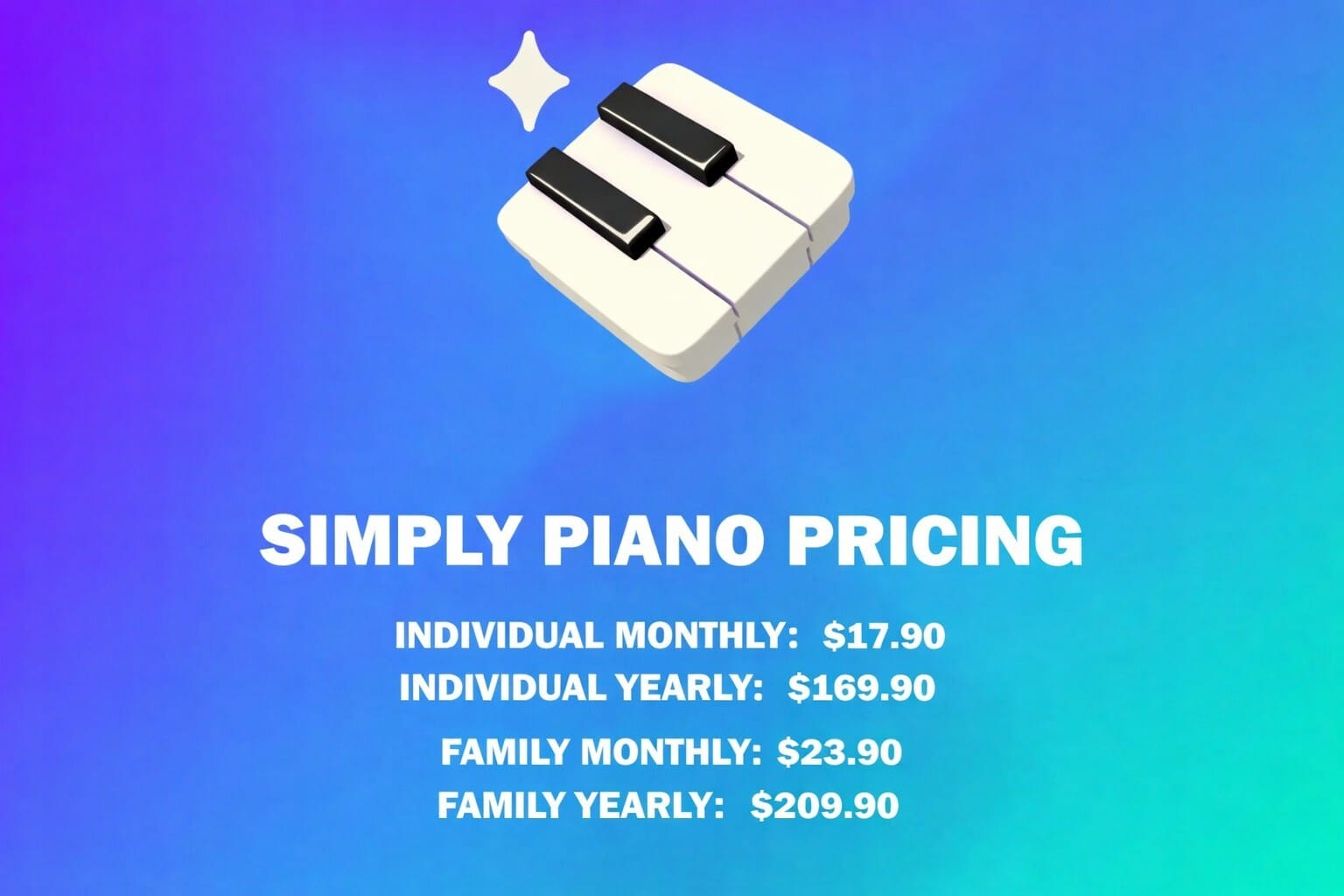
- Individual Monthly: $17.90
- Individual Yearly: $169.90
- Family Monthly: $23.90
- Family Yearly: $209.90 (up to 5 profiles, includes all Simply apps)
Prices are in USD and vary by region. There's a 14-day trial, plus the usual Black Friday discounts.
Now do the math the marketing doesn't want you to do. Two years to reach the app's ceiling means $340 spent to arrive at early intermediate, with no technique coaching along the way. For comparison, a one-time course like Pianoforall costs a fraction of a single year's subscription, and you own it forever.
Subscriptions make sense for content that keeps growing with you. Simply Piano's ceiling doesn't grow. You just keep paying rent on the same foundation.
So, is it worth it?
If you’re a total beginner with zero musical background and you just want to dip your toes in, maybe. But if you’re serious about learning piano… I’d say this shouldn’t be your only tool.
Who Should (and Shouldn't) Use Simply Piano
Let me be brutally honest.
✅ Reasonable pick if:
- You're buying it for a kid who needs gamified motivation.
- You're a casual dabbler who wants to noodle through pop songs.
- You've got a whole family learning together (the Family Plan is the one genuinely good deal here).
- You have zero interest in technique and just want low-stakes fun.
❌ Look elsewhere if:
- You're an adult who actually wants to learn piano. Seriously — this is the biggest one. Adults learn differently, don't need cartoon confetti, and are better served by structured, chord-first teaching like Pianoforall.
- You want to read real sheet music fluently or play beyond simplified arrangements.
- You care about posture, technique, and expression.
- You'd rather learn on a desktop than squint at a phone.
- You're allergic to subscriptions (understandable).
Can You Actually Learn Piano With It?
Up to a point, yes. And then the point arrives faster than you'd like.
Simply Piano is a microwave, not a kitchen. It'll get food on the table, but nobody becomes a chef with it. If you stay inside the app, you plateau. If you're serious, you'll eventually need real instruction, either a human teacher or a properly structured course.
Which brings us to the option I'd actually point most adults toward.
A Better Alternative?
I’ve tried a bunch of piano apps. If I had to recommend a better option for actually learning how to play, especially if you're an adult, it’s Pianoforall.
This course flips the script. It teaches you chords first, so you’re playing real songs immediately, and then works theory and reading into the mix later. Less robotic. More musical.
It’s cheaper too. One-time payment. No subscriptions. And you can download the lessons to use offline.
But it’s not as flashy. No pretty animations. Just solid teaching.
Final Verdict: Fine for Kids, Weak Value for Adults
Simply Piano isn't a scam. It's a well-built, genuinely fun on-ramp, and for children, it might be exactly the right amount of piano.
But strip away the polish and you're left with a $170/year note-checker that can't see your hands, can't refine your technique, and caps out at early intermediate. It's an appetizer priced like a main course.
If you're a kid (or buying for one): the free trial is worth a spin. If you're an adult who wants to actually learn: skip the subscription treadmill and start with something else.
Either way, don't buy the fantasy that any app alone makes you a musician. Real progress takes time, repetition, and a little discomfort, and no monthly fee has ever shortcut that.
TL;DR
- Is it fun? Yes, genuinely.
- Does it teach piano? Partially, and only the beginning.
- Is it worth $170/year? For kids, maybe. For adults, no.
If you’re dead serious about piano, start here if you must, but upgrade fast. If you just want to play “Let It Go” for your kids and bounce, then it might be perfect.
Whatever you do, don’t fall for the illusion that an app alone can make you a musician. It can’t.
Music takes time, effort, and some actual discomfort. And no subscription fee can shortcut that.
Updated July 2026
Comments ()