
8 Best Online Piano Lessons for 2026, Tested by a Teacher
On this page
Picking online piano lessons is easy to get wrong in a specific way: you sign up for the app with the flashiest ad, quit in six weeks, and blame yourself instead of the mismatch. I teach piano, and most of the students who come to me “starting over” already tried one of these platforms first. The problem usually wasn’t effort. It was picking a tool built for a different kind of learner.
Below are the 8 online piano lessons worth your money in 2026, with real pricing, honest drawbacks, and who each one actually fits.
Our Top Picks at a Glance
| Platform | Best for | Price | Rating |
|---|---|---|---|
| Pianoforall | Playing songs fast | $49 one-time | 4.9/5 |
| Simply Piano | Gamified beginners | $17.90/mo | 4.7/5 |
| Piano Marvel | Sight-reading and exams | Free tier, $17.99/mo premium | 4.5/5 |
| Playground Sessions | Structured song progression | $24.99/mo | 4.3/5 |
| Skoove | AI feedback on technique | $12.99/mo (billed yearly) | 4.0/5 |
| Pianote | Live teacher feedback | $19.99/mo | 3.9/5 |
| Flowkey | Huge song library | $19.99/mo | 3.8/5 |
| Piano by Pictures | Visual learners | 30 days free, then $37/mo | 3.8/5 |
If you want the short version: Pianoforall gets you playing real songs the fastest and it’s a one-time fee, not a subscription. Simply Piano works best if you’re easily bored and want the app nagging you back to the bench. Piano Marvel is the one to pick if you’re prepping for an exam or actually want to read music, not just mimic a screen. Everything else on this list earns its spot for a narrower reason, covered below.
How I Evaluated These
I judged each platform on seven things: curriculum quality, instructor expertise behind the content, how usable the interface actually is day to day, whether the feedback mechanism (mic, camera, or MIDI) works reliably, how much song variety is on offer, whether pricing is honest up front, and who each platform genuinely suits versus who it’s marketed to.
Two names you’ll see recommended elsewhere aren’t on this list. ArtistWorks leans classical and conservatory-style, which makes it a better fit for a dedicated “learning classical piano” guide than a general beginner roundup. Yousician spreads its lessons across guitar, bass, ukulele, and voice as well as piano, so the piano-specific depth doesn’t match the eight platforms below that build for piano and nothing else.
1. Pianoforall: Best for Adults
Price: $49
Our Rating: 4.9/5
Pianoforall is a $49 one-time purchase, not a subscription, and that alone puts it in a different category from most of this list. You get over 300 video lessons and 1,000 audio lessons plus nine interactive eBooks, covering jazz, blues, and classical styles. The course has taught over half a million people to play, and it works across devices.
The chord-first method is the real selling point. Instead of drilling scales for a month before you touch a real song, you learn a handful of chord shapes and start playing recognizable music almost immediately. That’s exactly the hook that works on adult beginners who quit lessons as kids because nothing sounded like music for the first year.
What I like: you’ll play recognizable songs quickly, the style range (pop, blues, classical) is wider than most competitors, and it’s extremely affordable next to a $20/month subscription.
Drawbacks: there’s no live feedback loop, so you won’t know if your timing is off unless you record yourself. The interface also feels a little dated compared to newer apps.
2. Simply Piano: Best for Gamified Beginners
Price: $17.90/month
Our Rating: 4.7/5
Simply Piano runs $17.90 a month and listens to you play through your device’s mic, giving real-time feedback as you go. It covers pop, classical, jazz, and country, and the app tracks your progress to adjust pacing automatically.
This is the one I recommend to parents asking about lessons for a distractible 10-year-old, or honestly, a distractible adult. The gamification actually works. It turns practice into something closer to a mobile game, which matters more than curriculum depth in the first few months, when the biggest risk isn’t bad technique, it’s quitting.
What I like: it’s fun and motivating, the song selection is wide, and it’s a solid fit for casual learners who want progress without much structure.
Drawbacks: it’s subscription-only, and serious students will outgrow the depth within a year or two.
3. Piano Marvel: Best for Sight-Reading and Exam Prep
Price: Free tier available; $17.99/month for Premium
Our Rating: 4.5/5

Piano Marvel has a genuinely useful free tier, with premium at $17.99 a month. It has over 25,000 songs and exercises, and its SASR tool (Standard Assessment of Sight Reading) is one of the only features on this list that actually measures reading ability instead of just note accuracy.
If a student tells me they’re preparing for an RCM or ABRSM-style exam, this is where I point them. The curriculum resembles a traditional print method more than the others here, which is a feature, not a limitation, if your goal is formal musicianship rather than casual playing. Monthly community challenges add a bit of competition for students who need that push.
What I like: it works for all skill levels, the sight-reading tools are unmatched on this list, and there’s a genuinely usable free tier.
Drawbacks: the interface isn’t the sleekest, and it works best with a MIDI keyboard connected, not just a mic.
4. Playground Sessions: Best for Structured Song Progression
Price: $24.99/month
Our Rating: 4.3/5
Playground Sessions costs $24.99 a month and scores your playing in real time, with lessons grouped into Rookie, Intermediate, and Advanced tiers. Quincy Jones co-created the curriculum, which shows up in how the song library leans toward recognizable, radio-friendly material rather than exercises.
It’s the priciest subscription here, and you’ll get more out of it if you connect a MIDI keyboard rather than relying on the mic. For a student who wants a clear, guided path from “Rookie” to “Advanced” without picking their own curriculum, that structure is worth the extra cost.
What I like: the video instruction is excellent, the song library is broad, and the guided learning path removes the guesswork.
Drawbacks: you need a MIDI keyboard to get the full experience, and it doesn’t focus much on improvisation.
5. Skoove: Best for AI Feedback on Technique
Price: $12.99/month for yearly subscription
Our Rating: 4.0/5

Skoove runs $12.99 a month on a yearly plan and uses AI-powered feedback on your timing, accuracy, and notes as you play. It adapts to your skill level and pairs ear training with reading music, which most gamified apps skip entirely.
The ear training piece is what separates this from Simply Piano or Flowkey. A student who can play a piece perfectly from notation but can’t recognize the melody by ear is missing something Skoove specifically addresses.
What I like: the AI feedback is genuinely useful, the theory and ear-training content is stronger than competitors, and the interface is easy to navigate.
Drawbacks: it’s not built for advanced players, and the best features sit behind the paywall.
6. Pianote: Best for Live Teacher Feedback
Price: $19.99/month
Our Rating: 3.9/5
Pianote is $19.99 a month for a full curriculum plus live support, artist-led lessons, and access to a student forum. You can submit a recording of your own playing and get a personalized response from an actual teacher, which is closer to traditional lessons than anything else on this list short of hiring one directly.
That human feedback loop is the entire value proposition. If you’ve hit a plateau you can’t diagnose yourself, a teacher watching you play for 90 seconds will often catch what months of app-based correction missed.
What I like: the video content is excellent, there are weekly live lessons, and the teacher support is real, not automated.
Drawbacks: it’s subscription-only, and classical training isn’t the focus here.
7. Flowkey: Best for Song Library Size
Price: $19.99/month
Our Rating: 3.8/5
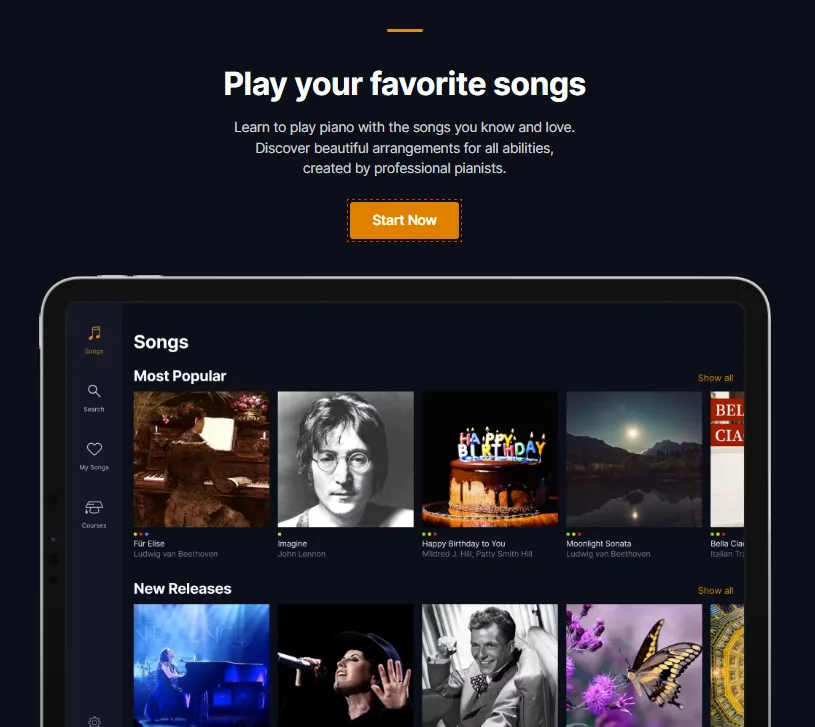
Flowkey costs $19.99 a month and gives you access to over 1,500 songs, shown through both notation and a hands-on video tutorial. It works with acoustic pianos as well as digital ones, which not every app on this list handles well.
If your goal is simply “play more songs I already like,” the library size does a lot of the work for you. The tradeoff is that Flowkey teaches you to play specific pieces more than it teaches you piano as a transferable skill.
What I like: the interface is polished, it works with acoustic pianos, and the song library is enormous.
Drawbacks: theory and technique coverage is thin, and it’s less structured than Piano Marvel or Playground Sessions.
8. Piano by Pictures: Best for Visual Learners
Price: 30 Days Free then $37 a month
Our Rating: 3.8/5
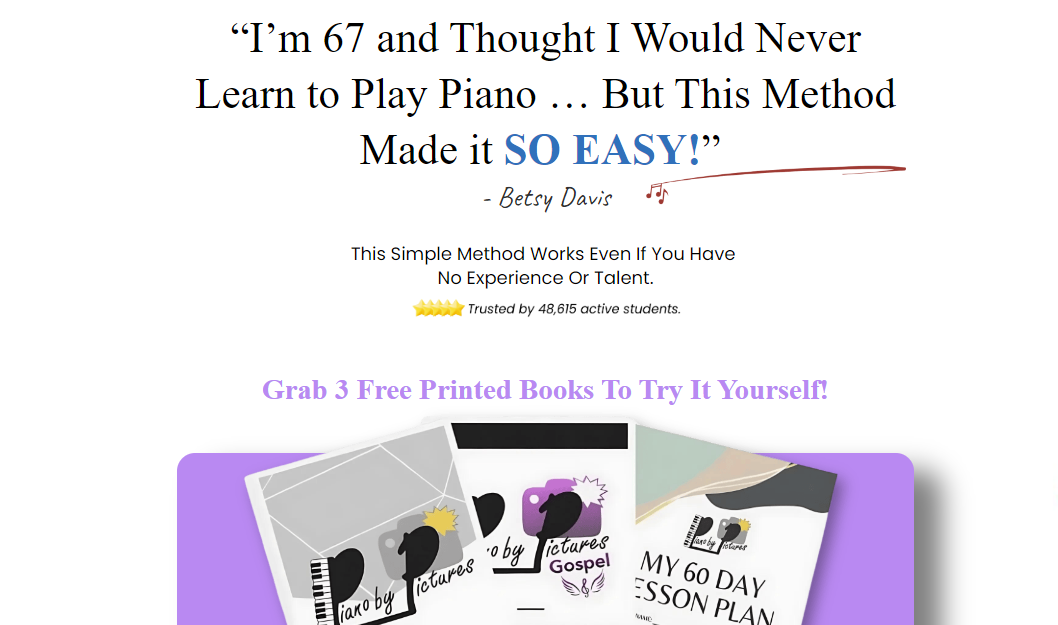
Piano by Pictures offers 30 days free, then runs $37 a month, the priciest subscription here. It teaches scale patterns, chords, and melody through images and diagrams instead of traditional notation, with a step-by-step structure and a dedicated Play by Ear module.
This one’s narrow by design. If sheet music has always felt like a foreign language to you, the visual-first approach removes that barrier entirely. If you’re comfortable reading notes already, you don’t need it.
What I like: it’s fantastic for visual learners, it simplifies concepts that trip up beginners elsewhere, and it builds creativity early.
Drawbacks: theory depth is light early on, and the price is high for what you get if you’re not the specific learner it’s built for.
The Starter Pack: What You Actually Need
You don’t need an acoustic piano to start. A digital piano with 61 or more weighted keys, like a Yamaha P-145 or Casio Privia, covers everything on this list. For app-based courses you’ll also want a smartphone or tablet, a stable internet connection, and if you’re eyeing Piano Marvel or Playground Sessions specifically, a MIDI cable to connect your keyboard to your computer or device.
How to Choose the Right One
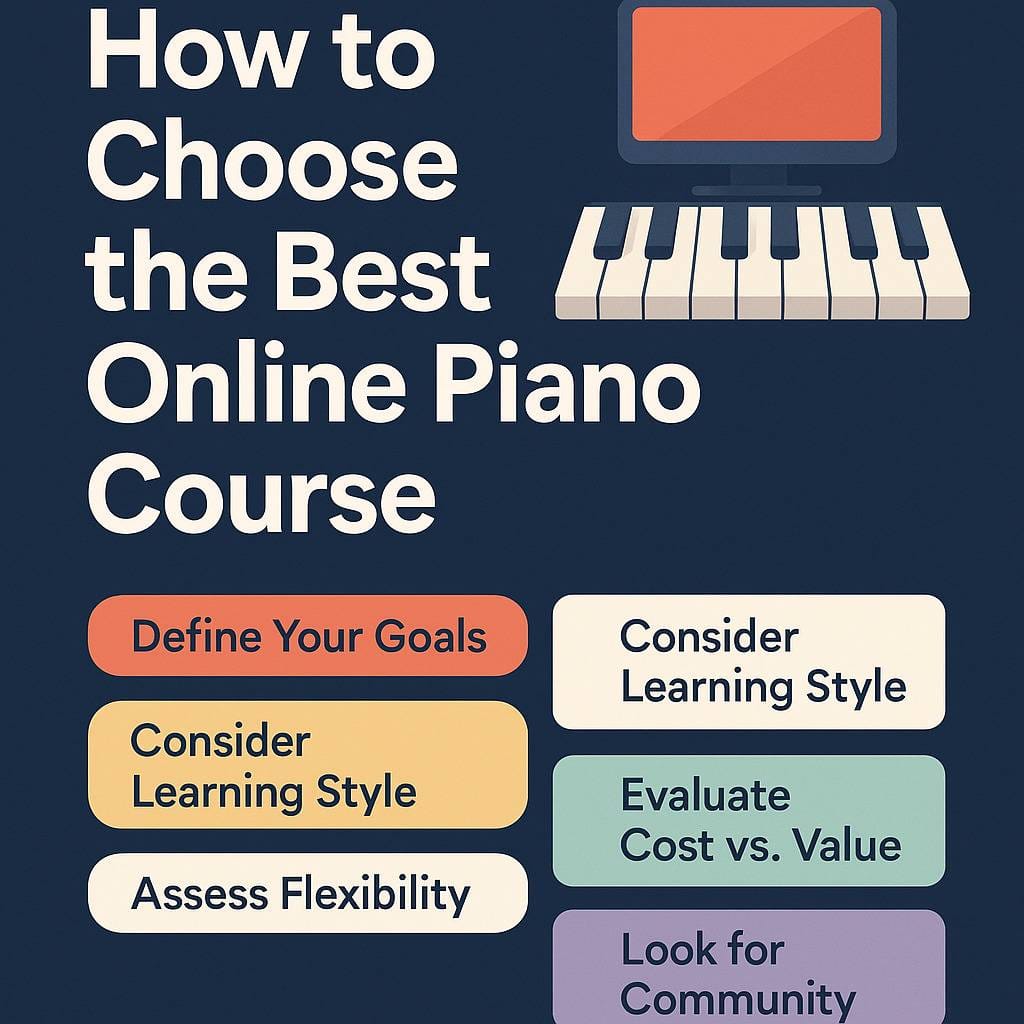
Six things actually matter here, and pricing isn’t the first one.
What do you actually want to play? Pop songs, classical pieces, or improvisation each point toward a different platform. Be honest about this before you look at price.
Match your learning style. Video-first learners tend to like Pianote. If gamification keeps you coming back, Simply Piano fits. If you want the app correcting you in real time rather than judging your video later, Skoove does that well.
Think about your schedule. Pianoforall gives you lifetime access to everything, so there’s no pressure to “keep up” with a subscription. Mobile-first apps like Flowkey suit people who practice in short, scattered windows rather than one long session.
Balance cost against value. A one-time $49 purchase and a $24.99/month subscription solve different problems even when the curriculum overlaps. Six months of Playground Sessions costs more than Pianoforall outright.
Don’t ignore community. Piano Marvel’s leaderboards and challenges keep some students motivated in a way solo practice never will. If you know you need external accountability, weight this higher than curriculum depth.
Always try before you commit. Every platform on this list offers some kind of trial. Use it to test whether the feedback mechanism (mic versus MIDI versus a real teacher) actually works with your setup before you pay for a year.
Final Thoughts
There’s no single best answer here, and I’d be lying if I gave you one. What decides whether you’re still playing in a year isn’t which platform ranks first on this page. It’s whether the platform matches how you actually learn. Pick based on that, practice consistently, and any of these eight will get you further than the piano sitting untouched in the corner right now.
Frequently Asked Questions
Are online piano lessons actually effective?
For most beginners, yes, they work comparably to in-person instruction. The one habit worth building regardless of platform: record yourself occasionally. It’s the fastest way to catch posture and hand-position issues that a screen won’t flag.
What equipment do I need for online piano lessons?
A digital keyboard with 61 or more keys is enough to start. You don’t need an acoustic piano, and most students shouldn’t buy one until they know they’re sticking with it.
How much do online piano lessons cost?
Monthly subscriptions on this list run $12.99 to $24.99. Pianoforall is the outlier at a $49 one-time fee with no recurring cost.
Which online piano lessons are best for complete beginners?
Pianoforall gets you playing songs fastest. Simply Piano works well if you need the app-based motivation to keep showing up. Piano by Pictures suits beginners who want to avoid reading traditional sheet music at first.
How long until I can actually play something?
With 20 minutes of daily practice, expect simple melodies within 2 to 3 weeks and basic two-hand songs within 2 to 3 months. That timeline holds across most of the platforms above, the differences show up more in what you’re playing than how fast.
Am I too old to start?
No. Adults often progress faster than kids in the first few months because practice is intentional rather than forced. Age isn’t the variable that predicts whether you stick with it. Consistency is.

Comments ()