
Piano Marvel Review (2026): The App That Teaches You to Read Music
A piano teacher's Piano Marvel review: what the free plan includes, Premium prices (checked Oct 2026), how the SASR sight-reading test works, and who should choose another app.
Some links on this page are affiliate links. If you buy through one, we may earn a small commission at no extra cost to you. It never decides what we recommend.
On this page
Quick answer
Is Piano Marvel worth it?
Yes, if you want to read music properly. Piano Marvel is the best app I know for sight-reading. It scores every note and rhythm you play, and its SASR test gives your reading a number you can watch go up. The free plan is real (150+ songs, 200+ lesson exercises, 25 video lessons), and Premium is $129.99 a year ($10.84 a month) or $17.99 a month. Skip it if you mainly want pop songs and chords fast: Pianoforall or Flowkey suit you better. Plug in a digital piano with a USB cable for the best results.
Piano Marvel at a glance
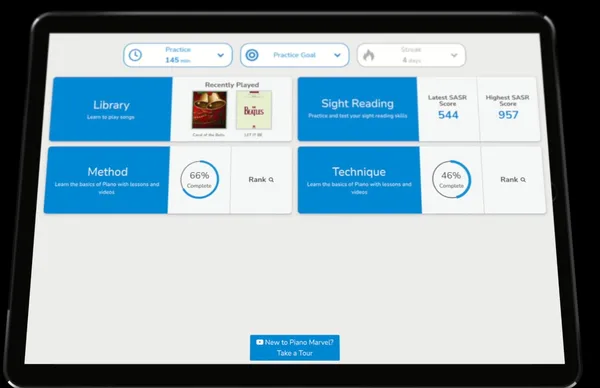
Verdict: 4.3 / 5. The most serious practice app for reading notation, with a free plan good enough to test it properly. Less fun than the game-style apps, and it works best with a cable.
- Price
- Free; $17.99/mo or $129.99/yr
- Levels
- Beginner to advanced (18 levels)
- Feedback
- Scores notes and rhythm
- Best input
- MIDI (USB or Bluetooth); microphone mode for acoustic pianos
- Works on
- iPhone, iPad, Android, Windows, Mac, Chromebook
What I like
- SASR measures reading, not just right notes
- A method course laid out like a good method book
- A free plan you can actually learn on
- 25,000+ songs, including Hal Leonard and Alfred titles
Drawbacks
- Feels like coursework, not a game
- Most accurate with a cable to a digital piano
- Some users report scoring errors and slow support
- Weak for learning by ear or improvising
I teach piano, and the question I hear most from adult beginners is "how do I get better at reading?" Most apps dodge it: they scroll falling notes or light up keys, so you can "play" a song without ever reading it. Piano Marvel does the opposite. It puts real sheet music in front of you and tells you exactly how well you read it. I used Piano Marvel on my digital piano, connected by USB, working through the Method, the song library and the SASR sight-reading test, so this review is based on what it's actually like to practise with it every day.
Here's what you get, what it costs, how the sight-reading test works, and who should choose something else.
What is Piano Marvel?
Piano Marvel is a piano lesson and practice app that listens to you play and scores you on note and rhythm accuracy. It was created by its founder and CEO, Aaron Garner, and is built around four sections:
- Method: a step-by-step course from first notes to classical repertoire, with short video lessons and graded exercises.
- Library: 25,000+ songs and pieces (the App Store listing says 30,000+), classical and popular, including sheet music licensed from Hal Leonard and Alfred Music. You can also upload your own music.
- Sight Reading: the SASR test and hundreds of reading drills. This is the section that sets it apart.
- Technique: scales, chords, arpeggios and exercises, scored the same way.
It runs on iPhone, iPad, Android, Windows, Mac and Chromebook. On iPhone and iPad it needs iOS 15 or later, and the App Store rating is 4.7 from about 5,500 ratings (October 2026).
How much does Piano Marvel cost?
Piano Marvel has a free plan and one paid plan, Premium, billed monthly or yearly. The yearly plan is the better deal: $129.99, which works out to $10.84 a month.
| Plan | Price | Songs | Lesson exercises | Video lessons | Also included |
|---|---|---|---|---|---|
| Free | $0 | 150+ | 200+ | 25 | Scoring and feedback, limited SASR tests |
| Premium (monthly) | $17.99 a month | 25,000+ | 1,200+ | 200+ | Unlimited SASR tests, upload your own music |
| Premium (yearly) | $129.99 a year ($10.84/mo) | 25,000+ | 1,200+ | 200+ | Same as monthly |
| Schools & studios | Quote | For teachers and schools | |||
About the trial. A new free account starts with Premium as a trial, then drops back to the free plan if you don't subscribe. Two details from the App Store terms: copyrighted songs aren't available during the trial, and if you subscribe before the trial ends, the unused trial days are lost. So take the whole trial before you pay. You can sign up without buying anything, and the trial length is shown when you create your account.
Is it worth paying? Over 12 months, Premium yearly costs $129.99. Simply Piano yearly is $169.90, Flowkey Premium $149.99 and Skoove $149.99, so Piano Marvel is the cheapest of the subscription apps. The one cheaper option is Pianoforall at $49 once, but it's a course of books and videos, and nothing listens to you play.
Is the free plan enough?
For a beginner's first month or two, yes. The free plan gives you scored lessons, 150+ songs and enough reading tests to get a baseline score. It won't last a whole year: you'll run out of Method lessons, and the big library is Premium only. My advice is to start free, take an SASR test in week one, and upgrade only if you're still practising and your score is moving in week three. On the free plan, the first thing I ran into was the Method: the free lessons run out quickly, and the big song library is Premium only.
How a Piano Marvel lesson works
Every exercise, song and test follows the same loop. It's the reason the app works.
- Watch the short video if there is one (Method lessons have them).
- Practise the piece: slow the tempo down, play hands separately and loop a hard bar. The app follows you as you play.
- Assess: play it through at tempo. The app scores note and rhythm accuracy from 0 to 100% and shows where you slipped.
- Repeat until you earn the score to move on. Trophies, streaks, challenges and leaderboards are there if they motivate you, and easy to ignore if they don't.
The habit it builds is the one teachers try to build by hand: slow, accurate practice, then a real run-through, then an honest result. In my own lessons, the scored run-through caught small rhythm slips, like a rushed dotted note, that I didn't notice while playing. A teacher would catch those, but practising alone you usually don't.
The SASR sight-reading test, explained
SASR stands for Standard Assessment of Sight Reading. It's a test that gives your sight-reading a score, so you know your level and can watch it improve. Nothing else on the app market does this as well. Here's exactly how it runs:
- You pick a starting point: beginner, intermediate or advanced.
- A short piece you've never seen appears. You get 20 seconds to look it over, then a countdown, and you play.
- Score 80% or more and the next piece is harder. Score under 80% and you get a strike.
- After three strikes the test ends and you get your SASR score.
The pieces are spread across 18 levels split into 90 sublevels, from 1a to 18e. Each piece was placed by averaging the scores of a team of about 40 sight-readers, so a level means the same thing for everyone. The top score is 1,900. Piano Marvel's own examples give a sense of scale: a score of 189 or below is an early beginner, and 1,436 is the level of a professional accompanist.
How to use it: take the test in week one, practise the reading drills for 10 minutes a day, and retest every two to four weeks. A rising score shows progress that's otherwise hard to feel. Taking the test myself, the most useful part was the three-strikes format: it finds the edge of your reading level quickly and honestly, and it shows you exactly which level to practise at.
Not sure where you'd land? Piano Marvel has a free sample test on its site, and the full test is free with an account.
The Method course
The Method is the guided path, and it reads like a well-planned method book: notes and rhythm first, then hands together, scales and chords, and later classical pieces from the main periods. Each step adds one idea, with a short video and a set of exercises you must pass to move on. Theory comes in as you need it, not in separate lectures.
It suits anyone who likes structure: adults who want to "learn properly", children with a parent or teacher keeping them on track, and returning players filling gaps. It's less suited to someone who wants to play a pop song this weekend. The early levels are exercises, not hits.
The song library
Premium opens 25,000+ songs and pieces at every level, from easy classics to film and pop arrangements, including sheet music licensed from publishers such as Hal Leonard and Alfred Music. Every piece is scored the same way as a lesson, which turns your repertoire into practice.
You can also upload your own music (MusicXML or MIDI files) and slice it into practice sections. It's powerful but fiddly. Several App Store reviewers say uploads are hard to manage on iPad, so do this part on a computer.
What you need: MIDI or microphone
Piano Marvel listens to you in one of two ways, and the choice matters more than in most apps.
- MIDI (recommended). Connect a digital piano or keyboard to your tablet, phone or computer. The app then knows exactly which key you pressed and when, so the scoring is precise. Most current digital pianos have a "USB to Host" port: you need a USB-B to USB-C (or Lightning, or USB-A) cable, about $10. Some pianos also connect by Bluetooth MIDI, with no cable at all.
- Microphone. For acoustic pianos. Piano Marvel calls this mode new, and results vary with room noise and the piano. It's fine for trying the app, but for scored tests a MIDI connection is far more reliable.
On which piano: use an 88-key digital piano with weighted keys. The method's later levels use the full range of the keyboard, and weighted keys build the finger strength you'll need on any real piano. The Yamaha P-145, our top beginner pick, connects with one USB cable. Setting it up myself was simple once I had the right cable: plug the piano in, choose MIDI as the input in the app's settings, and play a few notes to check it hears you. The only snag is the first time, when you need a MIDI-capable keyboard, the right cable and a steady internet connection.
What I liked, and what frustrated me
What I liked
- It teaches reading. Real notation from day one, and a test that proves you're improving.
- Feedback is honest. A score you can't fudge. Adults practise better with a number to beat.
- It works for every level. Beginners get the Method. Intermediate and advanced players get SASR, Technique and the library.
- Good value. The cheapest subscription app on our best online piano lessons list, with a free plan you can learn on.
What frustrated me
- It feels like homework. The look is busy and serious. If you need fun to keep going, a game-style app may suit you better.
- Scoring isn't perfect. App Store reviewers mention grace notes scored as full notes and the odd wrong fingering. It's rare, but it's annoying in a test.
- Support can be slow, according to several reviews. The developer does reply to reviews on the App Store.
- Little for ear players. There's ear training, but improvising, chord-based playing and playing by ear aren't its focus.
What frustrated me most was the interface. It's busy, and it took me a few sessions to find my way around the Method, the library and the reading drills. Once I had, I stopped noticing it.
What other users say
Across Reddit's piano-learning communities, Piano Marvel is one of the most recommended apps for sight-reading. Readers praise the reading drills, the theory and the structure, and often describe it as the closest an app comes to traditional lessons. The common complaints match mine: it's less fun than Simply Piano or Flowkey, and it works best with a MIDI cable. On the App Store it holds 4.7 out of 5 from about 5,500 ratings. Praise goes to the structure and the instant feedback, and the low ratings mostly mention scoring glitches, slow support and uploads.
Who should use Piano Marvel, and who shouldn't
| You… | Piano Marvel? |
|---|---|
| want to read sheet music fluently | Yes, this is what it's best at |
| are preparing for a grade exam or audition | Yes: SASR plus graded repertoire |
| have a teacher and want scored practice at home | Yes. Many teachers use it this way. |
| are a returning player with rusty reading | Yes. Start with an SASR test. |
| are an adult beginner who likes structure | Yes, start with the Method |
| want to play pop songs with chords, fast | No: Pianoforall |
| want a huge library of song tutorials | No: Flowkey |
| are a young child who needs games to stay engaged | Maybe: Simply Piano is more playful |
| only have an acoustic piano and no cable option | Maybe: try the microphone mode on the free plan first |
Piano Marvel vs the alternatives
| App or course | 12-month cost | Listens to you? | Teaches reading | Best for |
|---|---|---|---|---|
| Piano Marvel | $129.99 (or free) | Yes, MIDI or mic | Excellent | Sight-reading, exams, structure |
| Simply Piano | $169.90 | Yes, mic | Basic | Kids, game-style practice |
| Flowkey | $149.99 | Yes (Wait Mode) | Some | Learning songs you love |
| Playground Sessions | $149.99 (first year often $99.99) | Yes, MIDI | Some | A guided path of pop songs |
| Pianoforall | $49 once | No | Later in the course | Chords and songs fast, adults |
Piano Marvel vs Simply Piano. Simply Piano is more fun and gets beginners playing simplified songs within minutes, but its notation and reading work are light. Piano Marvel is slower to love and better for real reading. Children who need games: Simply Piano. Anyone who wants to read music: Piano Marvel.
Piano Marvel vs Flowkey. Flowkey is about learning particular songs, with a polished player and a big library. Piano Marvel is about learning to play from notation in general. If your goal is "my five favourite songs", choose Flowkey. If it's "read anything put in front of me", choose Piano Marvel.
Piano Marvel vs Playground Sessions. Both score you through MIDI and both are structured. Playground Sessions builds its path around popular songs. Piano Marvel builds it around reading and classical method, and costs less per year.
Piano Marvel vs Pianoforall. They teach different halves of the piano. Pianoforall ($49 once, 60-day money-back guarantee) starts with chords and rhythm styles, so adults play real-sounding songs early. Piano Marvel starts with reading. For many adult beginners I'd suggest both: Pianoforall for chords and confidence, plus Piano Marvel's free plan for 10 minutes of reading a day. Together that's $49, and $0 a month.
Want the full ranking? See the 8 best online piano lessons, with a 30-second quiz that matches you to one.
Your first week with Piano Marvel
- Day 1: create a free account, connect your digital piano with a USB cable, and pick MIDI as the input. Play a few notes to check that it hears you.
- Day 1: take the SASR test. Write your score down.
- Days 2–6: 20 minutes a day: 10 on the Method (or the library, if you're past beginner), 5 on reading drills, 5 on one Technique exercise.
- Day 7: decide. If you practised on at least five days and the scores are climbing, the yearly plan is good value. If you dreaded opening it, try Flowkey or Pianoforall instead.
For practice habits that make any app work better, see how to practice piano. If you're starting from zero, read how to learn piano by yourself first.
Final verdict
Piano Marvel is the app I'd choose to learn to read music. The SASR test is unique, the Method is well paced, the free plan is generous, and $129.99 a year undercuts the other big apps. It isn't the most fun, and it wants a cable to your digital piano. If you're after songs and chords fast, Pianoforall or Flowkey will suit you better. If you want to sit at a piano, open sheet music and play it, start here.
Piano Marvel FAQ
Is Piano Marvel free?
Yes, there's a free plan with 150+ songs, 200+ lesson exercises, 25 video lessons and scored feedback. Premium, with 25,000+ songs, 1,200+ exercises and unlimited SASR tests, costs $17.99 a month or $129.99 a year.
Is Piano Marvel good for beginners?
Yes, especially adult beginners who want to learn to read music. The Method course starts from your first notes. Beginners who mainly want to play popular songs quickly may prefer Pianoforall or Flowkey.
Does Piano Marvel work with an acoustic piano?
Yes, through its microphone mode, but results vary with the room and the piano. For accurate scoring, use a digital piano or keyboard connected by USB or Bluetooth MIDI.
What devices does Piano Marvel work on?
iPhone and iPad (iOS 15 or later), Android, Windows, Mac and Chromebook.
What is a good SASR score?
Scores go up to 1,900. Piano Marvel describes 189 or below as an early beginner and about 1,436 as the level of a professional accompanist. What matters most is your own score rising over time. Retest every two to four weeks.
Is Piano Marvel better than Simply Piano?
For learning to read music, yes. Simply Piano is more playful and better for young children who need games to stay engaged.
How do I cancel Piano Marvel?
Cancel where you subscribed. In the App Store or Google Play, turn off auto-renew in your subscriptions at least 24 hours before the period ends. If you subscribed on the website, cancel from your Piano Marvel account or ask its support team. Your account then returns to the free plan.
How I reviewed Piano Marvel
I used Piano Marvel myself on a digital piano connected by USB: the free plan and Premium, the Method lessons, the song library and the SASR test. I also read its App Store reviews (4.7 from about 5,500 ratings) and Reddit discussions to check my experience against other learners'. Prices and plan details come from pianomarvel.com/pricing (checked Oct 18, 2026). SASR details come from Piano Marvel's own description of the test, and device and trial terms from its App Store listing. Piano Marvel didn't review or pay for this article. See who we are.

Comments ()