
Roland FP-10 Review: The Best Key Feel Under $500
Real piano keys for about $500. My honest Roland FP-10 review: the PHA-4 keys, the sound, the weak speakers, and who should buy the Yamaha P-145 instead.
Some links on this page are affiliate links. If you buy through one, we may earn a small commission at no extra cost to you. It never decides what we recommend.
On this page
If you want real piano keys for about $500, the Roland FP-10 is the one I keep coming back to. It's Roland's cheapest 88-key digital piano, but it has the same PHA-4 Standard key action as the pricier FP-30X. Escapement, ivory-feel key tops, the lot. I've played it for long practice sessions, put students on it, and carried it between rooms more times than I can count. Here's my honest take: what it does brilliantly, where it cuts corners, and who should buy something else.
Quick answer
Is the Roland FP-10 worth it?
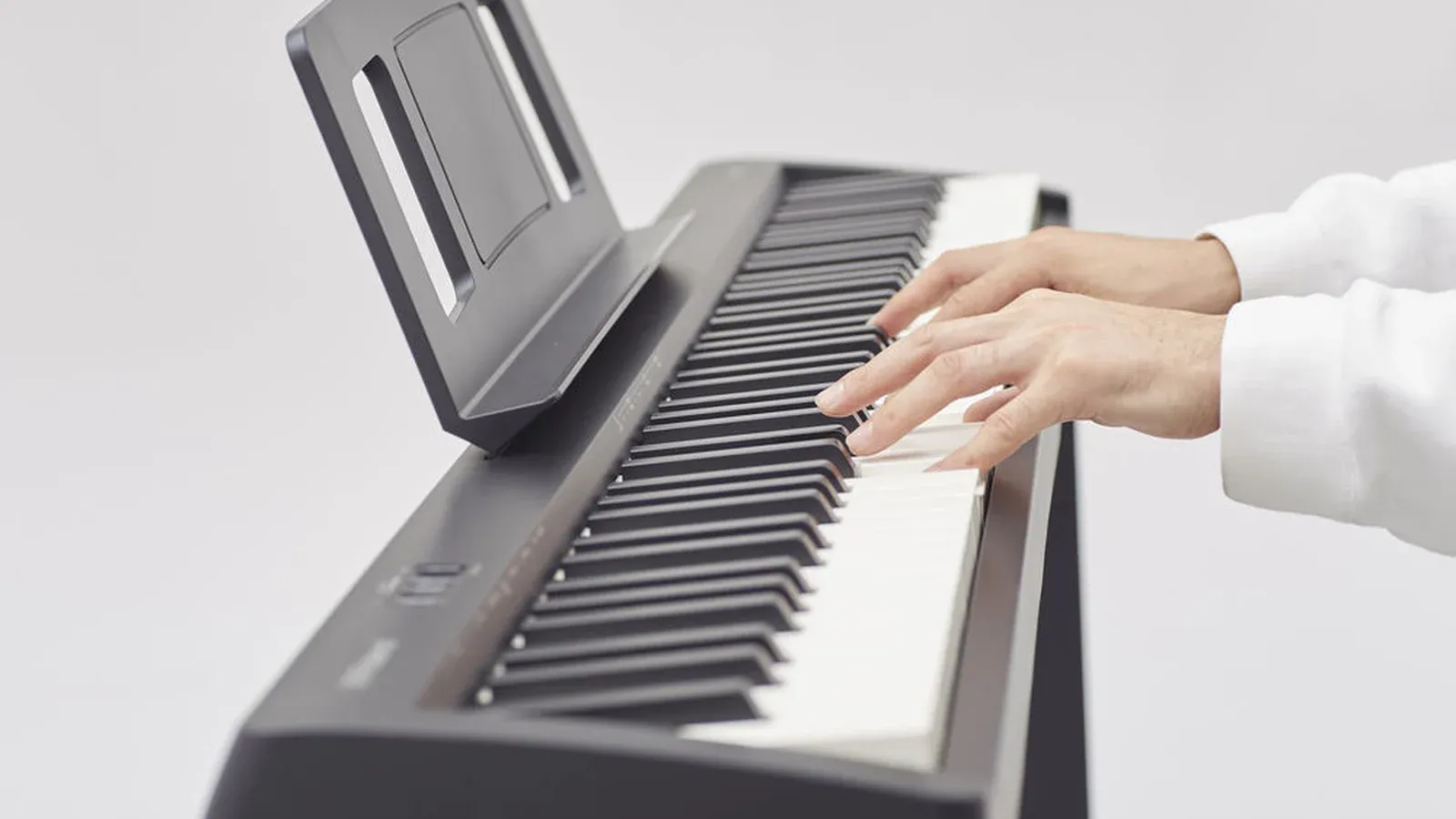
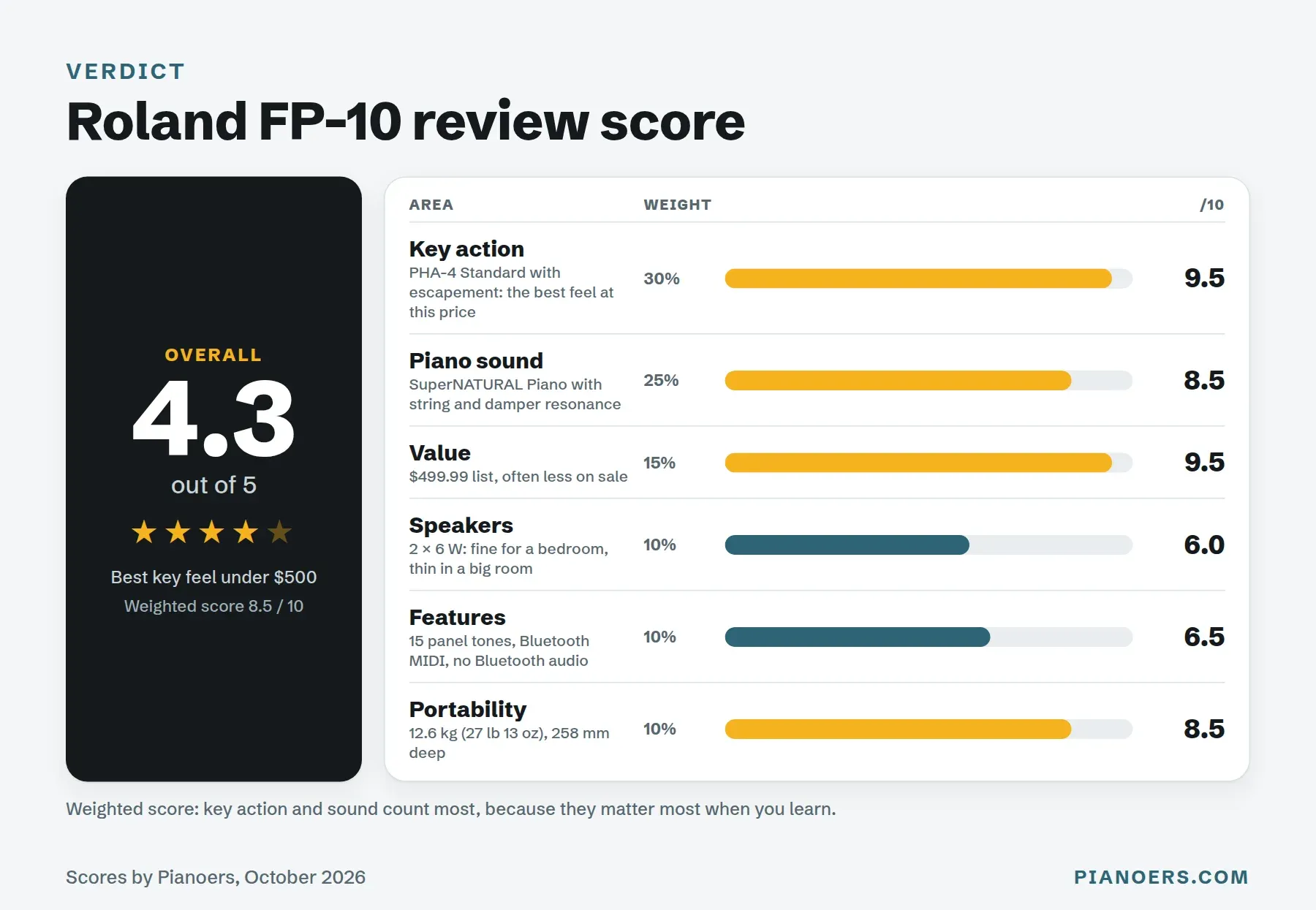
Yes, if key feel is your priority. The FP-10 has the best-feeling keys you can buy for about $499.99: Roland's PHA-4 Standard action with escapement, plus the SuperNATURAL Piano sound and Bluetooth MIDI for learning apps. The trade-offs are small 2 × 6 W speakers, no Bluetooth audio, one 3.5 mm headphone jack and only 15 sounds on the panel. If you want lighter keys and Bluetooth audio, the Yamaha P-145BT is the alternative. My score: 4.3 out of 5.
My verdict on the Roland FP-10
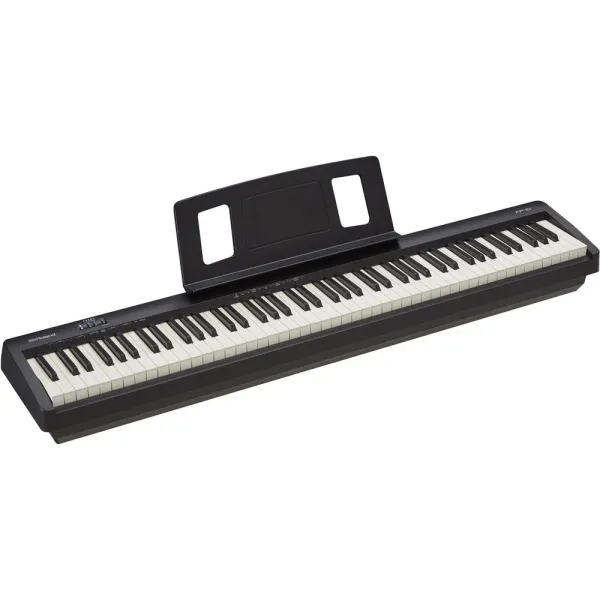
“Entry-level price, but definitely not entry-level keys.”
Verdict: The best key action under $500, with an expressive piano sound, held back only by small speakers and a bare-bones feature list.
- Action
- PHA-4 Standard
- Polyphony
- 96
- Bluetooth
- MIDI only
- Weight
- 27 lb 13 oz
What I love
- PHA-4 Standard keys with escapement and ivory feel
- Expressive SuperNATURAL Piano sound
- Bluetooth MIDI for learning apps, no cable needed
- Twin Piano mode for lessons
What bugs me
- Small 2 × 6 W speakers
- No Bluetooth audio
- One 3.5 mm headphone jack only
- Basic on/off pedal switch in the box
Roland FP-10 specs: what you actually get
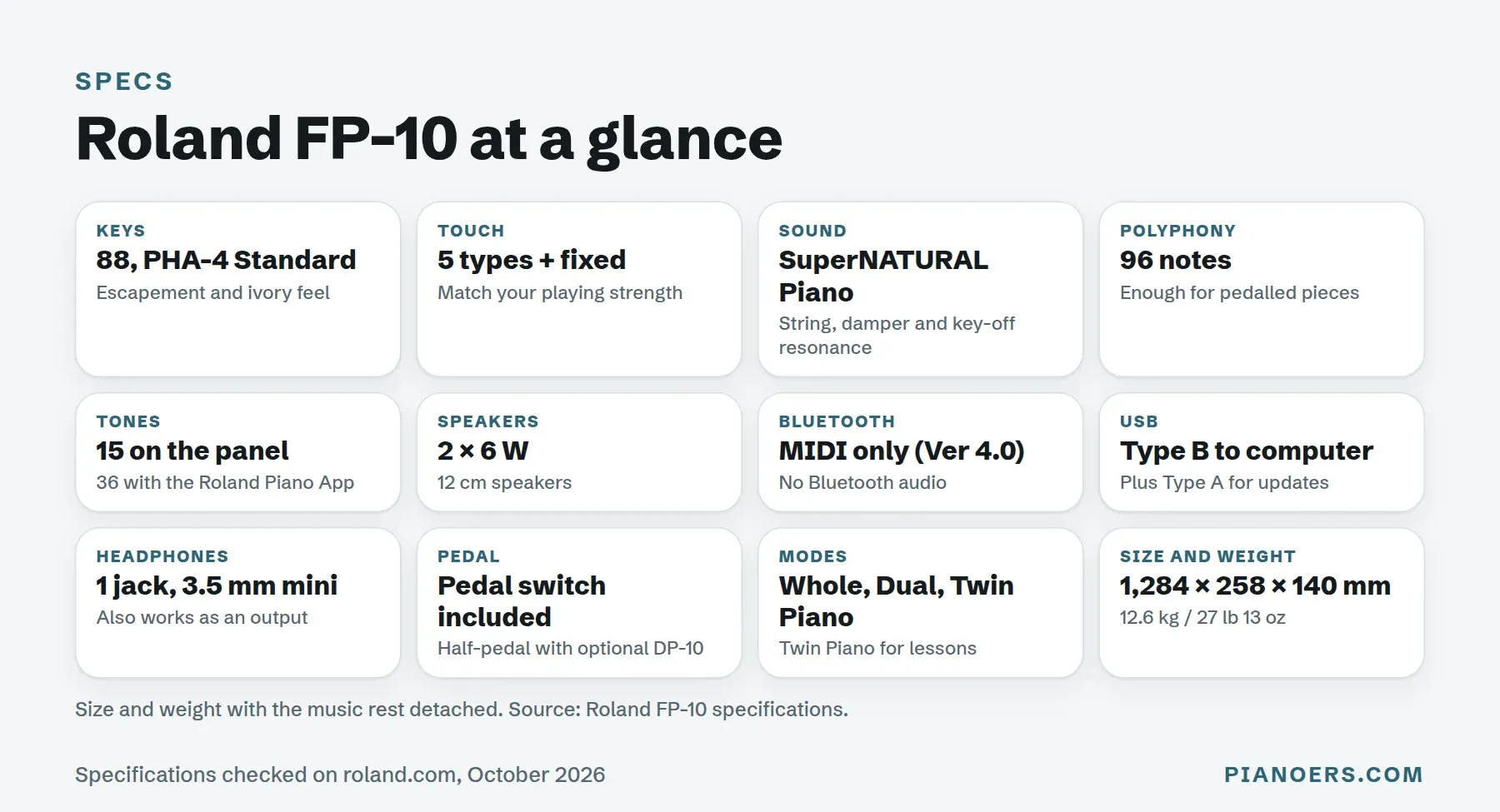
Here's everything that matters, checked against Roland's own specification sheet.
| Spec | Roland FP-10 |
|---|---|
| Keys | 88, PHA-4 Standard with escapement and ivory feel |
| Touch sensitivity | 5 types, plus fixed |
| Sound engine | SuperNATURAL Piano, with string, damper and key-off resonance |
| Polyphony | 96 notes |
| Tones | 15 from the panel, 36 with the Roland Piano App |
| Keyboard modes | Whole, Dual, Twin Piano |
| Metronome | Yes, 10 to 500 bpm, 14 time signatures |
| Speakers | 2 × 12 cm, 6 W × 2 |
| Bluetooth | MIDI (version 4.0), no audio |
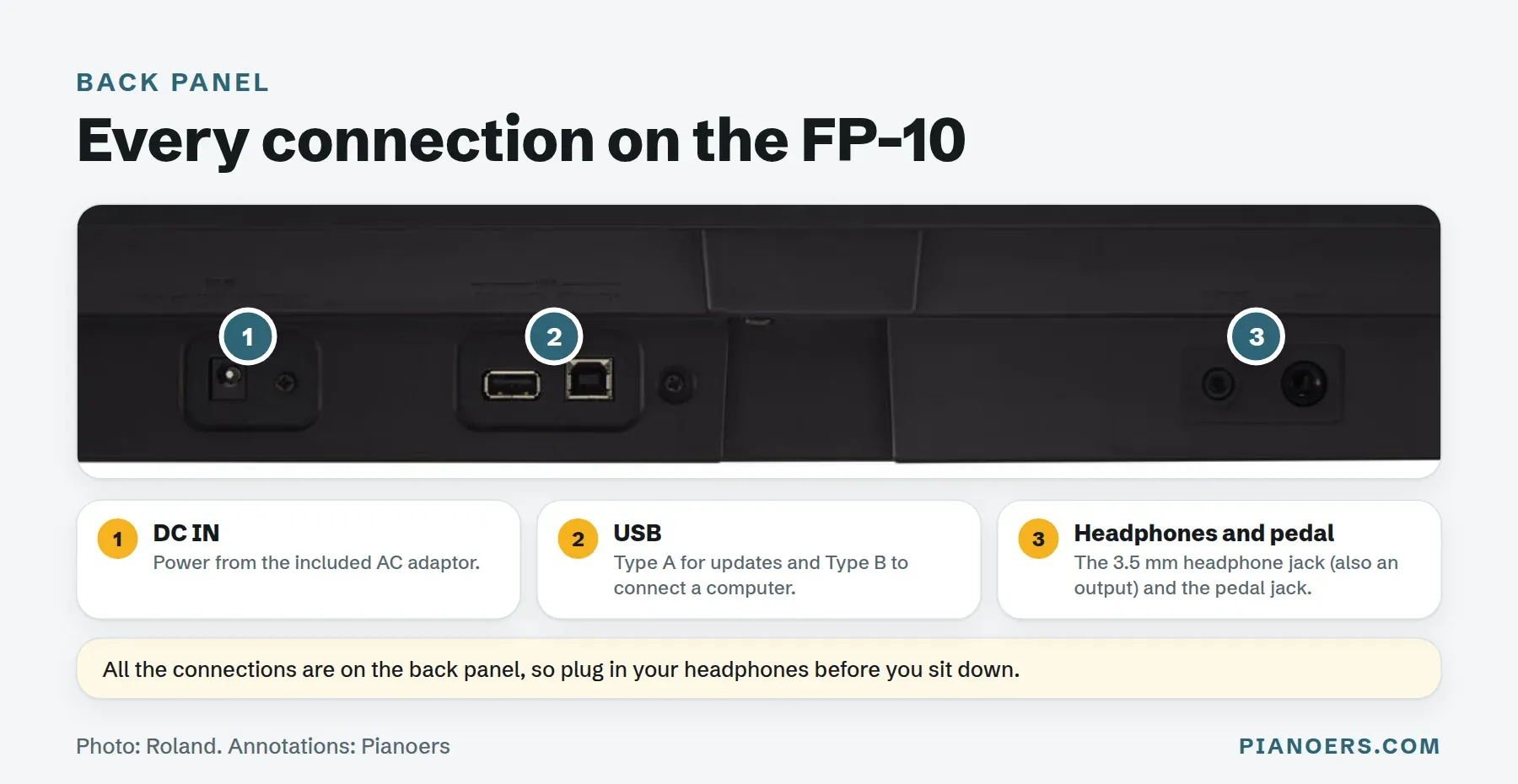
| Connections | USB Type B (computer), USB Type A (updates), one 3.5 mm headphone jack (also an output), pedal |
| In the box | Music rest, AC adaptor, pedal switch |
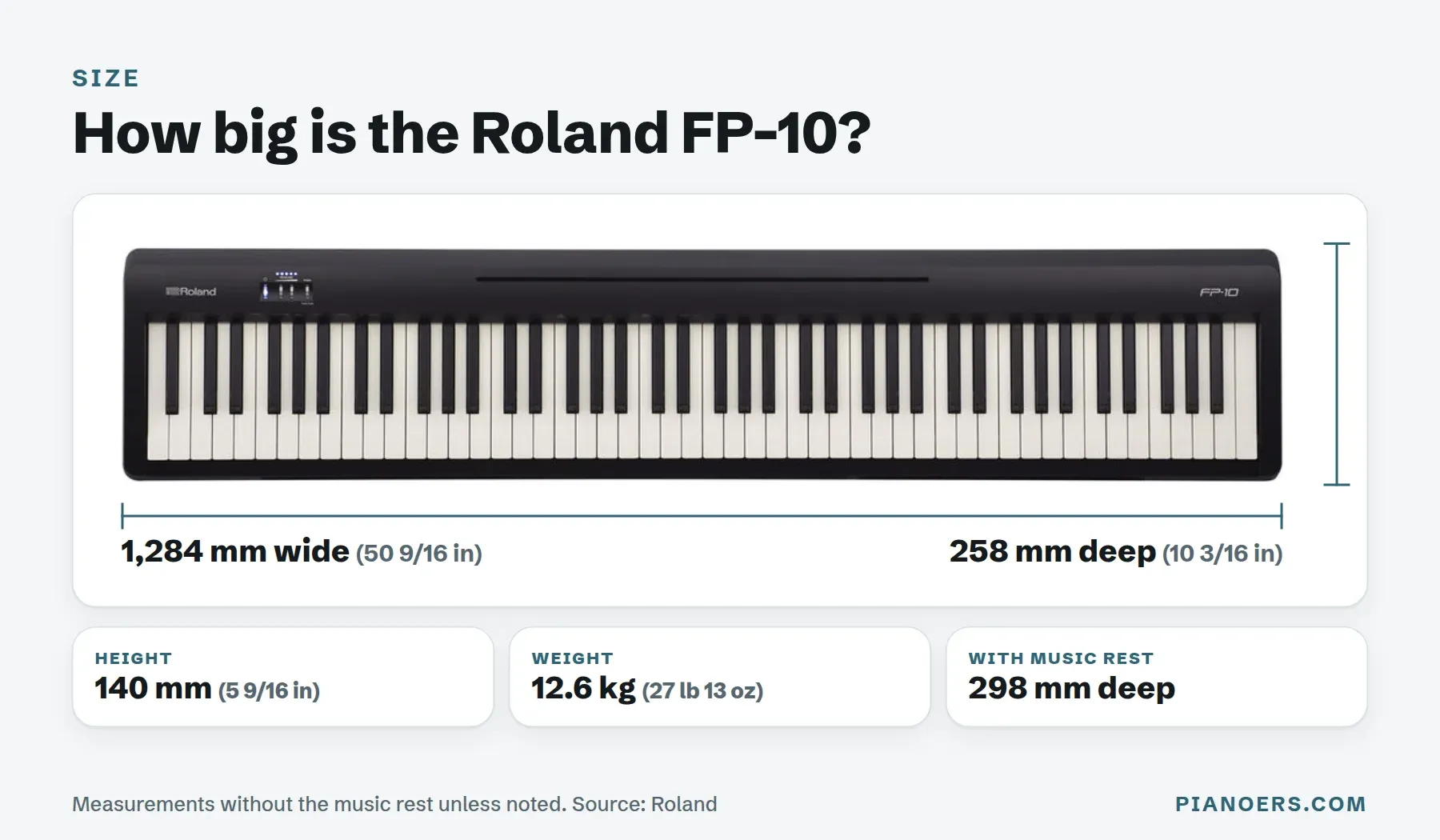
| Size | 1,284 × 258 × 140 mm (50 9/16 × 10 3/16 × 5 9/16 in) without music rest |
| Weight | 12.6 kg (27 lb 13 oz) without music rest |
| Price | $499.99 list in the US |
It's compact for a full 88-key piano: barely more than 10 inches deep, so it fits on a desk or a slim stand.
How the FP-10 feels: the PHA-4 Standard action
This is the reason to buy the FP-10. The first time you sit down, the keys feel serious. They're properly weighted, heavier in the bass and lighter at the top, and they push back the way a real piano does. Most pianos at this price feel fine. This one feels like an instrument.
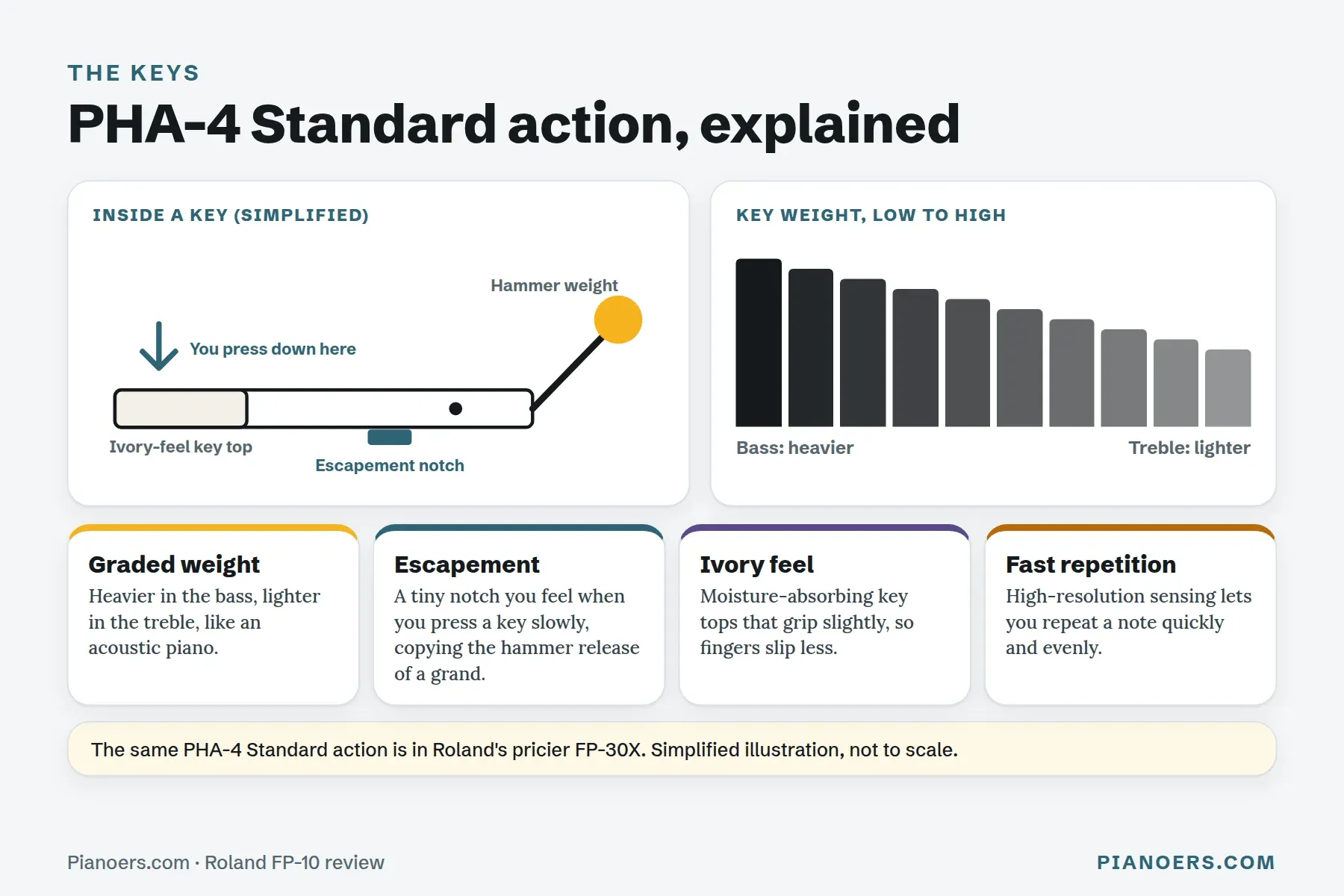
Three things make it stand out:
- Escapement. Press a key slowly and you feel a tiny notch near the bottom, like the hammer release on a grand piano. It's subtle, but it's one more way the FP-10 trains your fingers for a real piano.
- Ivory-feel key tops. Roland uses a moisture-absorbing material on the white keys. On long sessions, especially when it's warm, my fingers slip less than on glossy plastic keys.
- Fast, even repetition. Repeated notes and trills come out evenly, which helps when you start playing faster pieces.
The honest downside: the keys are heavier and a little louder mechanically than the Yamaha P-145's GHC action. If you practise with headphones at night, someone in the same room will hear a soft thumping. Some players love the heavier feel; a few beginners find it tiring at first. If you're coming from an acoustic piano, you'll probably feel right at home.
The same PHA-4 Standard action is in Roland's FP-30X, which costs about $150 to $200 more. So with the FP-10, you're getting Roland's mid-range keys at an entry-level price.
How it sounds: SuperNATURAL Piano
The FP-10 uses Roland's SuperNATURAL Piano sound. What I like most is how it responds to how hard you play: soft notes sound genuinely soft and round, not just quieter, and loud chords get brighter and fuller. String resonance, damper resonance and key-off resonance are always on, so pedalled chords bloom the way they do on an acoustic piano.
You can shape the sound a little with Ambience (room reverb) and Brilliance (brighter or mellower), and there are 15 tones on the panel, including electric pianos, organ and strings. Open the Roland Piano App and you get 36 in total. It's not a sound playground, and it doesn't try to be.
The 96-note polyphony is plenty for beginner and intermediate music, including pieces with lots of sustain pedal. It's more than the P-145's 64 notes, though well short of the FP-30X's 256.
Here's what it sounds like, with no talking, just playing:
Speakers and headphones: the weak spot
The two 6-watt speakers are the FP-10's biggest compromise. In a bedroom or a small living room, they're clear and loud enough for practice. In a bigger room, or when you want deep, full bass, they sound small. That's normal at this price, but it's worth knowing.
Headphones change everything. The SuperNATURAL sound is much more impressive through a decent pair, and you get to practise at any hour. Two things to know:
- There's one headphone jack, and it's a 3.5 mm mini jack. Phone-style headphones plug straight in. Studio headphones with a big 6.3 mm plug need a simple adapter.
- The same jack doubles as an output. If you want more volume, you can run a cable from it to powered speakers or an amplifier. There's no separate line out.
Bluetooth, USB and apps
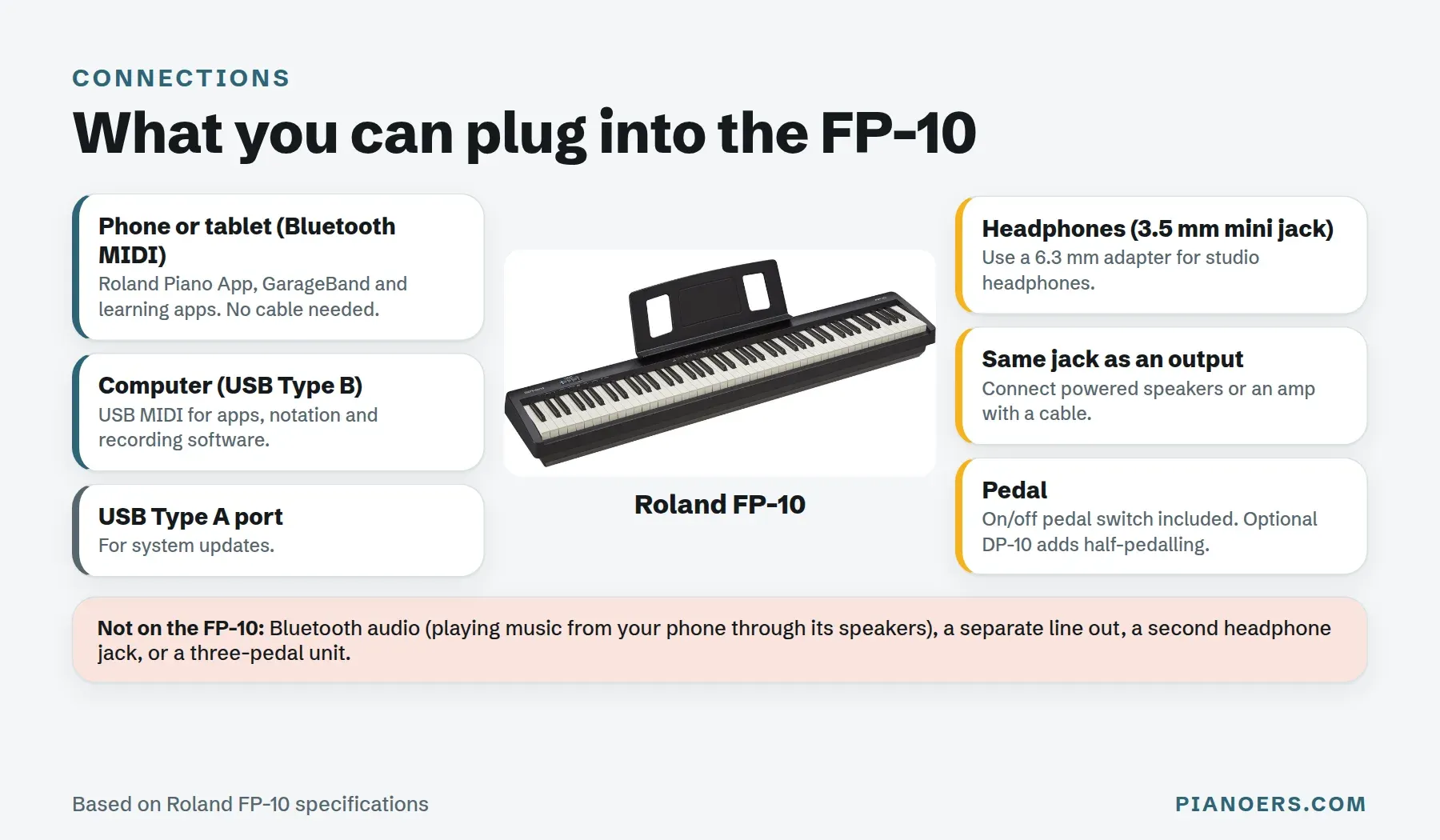
The FP-10 has Bluetooth MIDI, which is genuinely useful for learners. It connects wirelessly to your phone or tablet, so apps can "hear" exactly which keys you play and how hard. With the free Roland Piano App, you can choose sounds, set the metronome and reach all 36 tones from your phone. (The app's rhythm feature isn't available on the FP-10.) It also works with GarageBand, and with learning apps that accept MIDI. If you're choosing one, see my guide to the best piano learning apps, or compare full courses in the best online piano lessons.
What it doesn't have is Bluetooth audio. You can't stream a song or a YouTube lesson from your phone through the piano's speakers. For that, you'd need the FP-30X or the Yamaha P-145BT. There's also a USB Type B port for connecting to a computer (MIDI for apps, notation and recording software) and a USB Type A port that Roland uses for updates.
All the connections, the headphone jack included, are on the back panel. It keeps the front clean, but you'll be reaching around the back to plug in headphones, so it's worth leaving them plugged in.
Features for learning
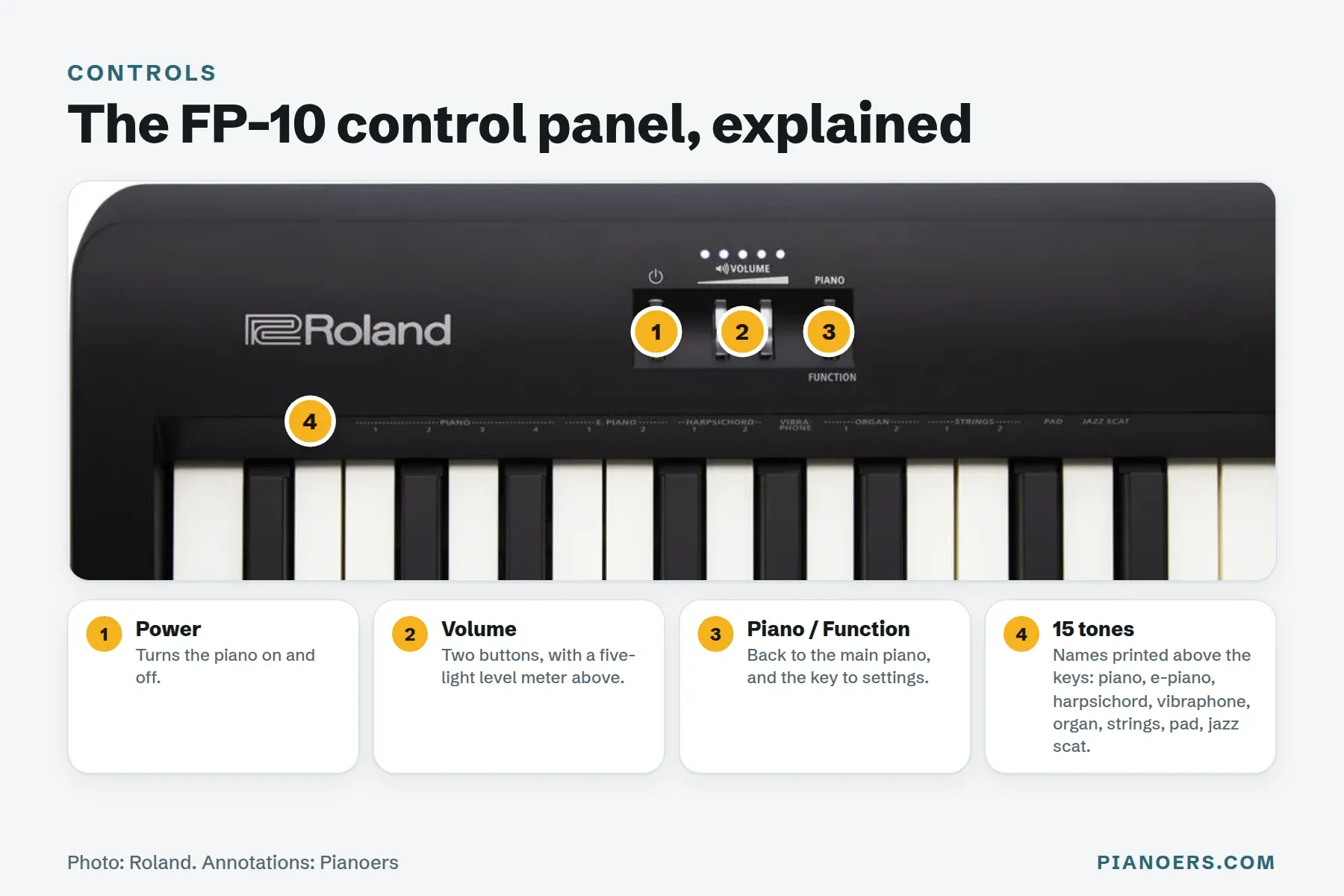
The panel is about as simple as it gets: a power button, two volume buttons and a Piano/Function button. The 15 tone names are printed right above the keys, and you choose them with the Function button and the key under each name (the owner's manual lists every shortcut). It's clean and uncluttered, though settings without a screen take a little getting used to. The Roland Piano App makes them much easier.
- Built-in metronome from 10 to 500 bpm, with 14 time signatures. Use it every day; my teach-yourself guide shows you how.
- Five touch settings plus fixed, so lighter or stronger players can match the response to their hands.
- Dual mode layers two sounds, such as piano and strings.
- Transpose shifts the pitch so you can play in an easy key and sound in another.
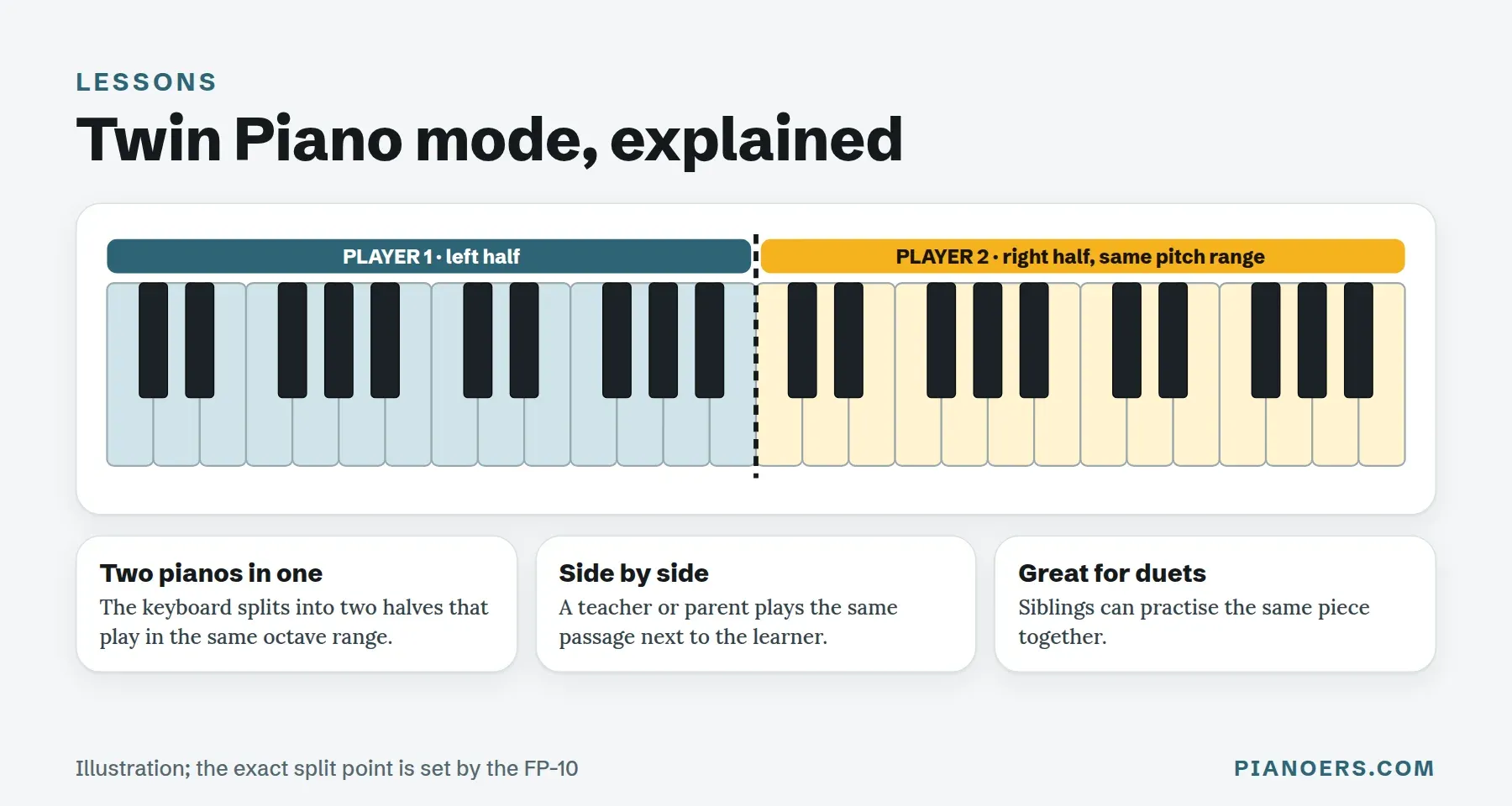
- Twin Piano mode splits the keyboard into two halves in the same pitch range. It's brilliant for lessons: a teacher or parent plays the same passage right next to the learner.
There's no built-in recorder listed in Roland's specs, so if you want to record yourself, use your phone or a computer over USB. It's worth it: hearing yourself back is one of the fastest ways to improve.
What's in the box, and what else to buy
In the box you get the FP-10, a music rest, the AC adaptor and a small pedal switch. That pedal works as a simple on/off sustain, but it's tiny, it slides around, and it can't do half-pedalling. It's the first thing I'd upgrade.
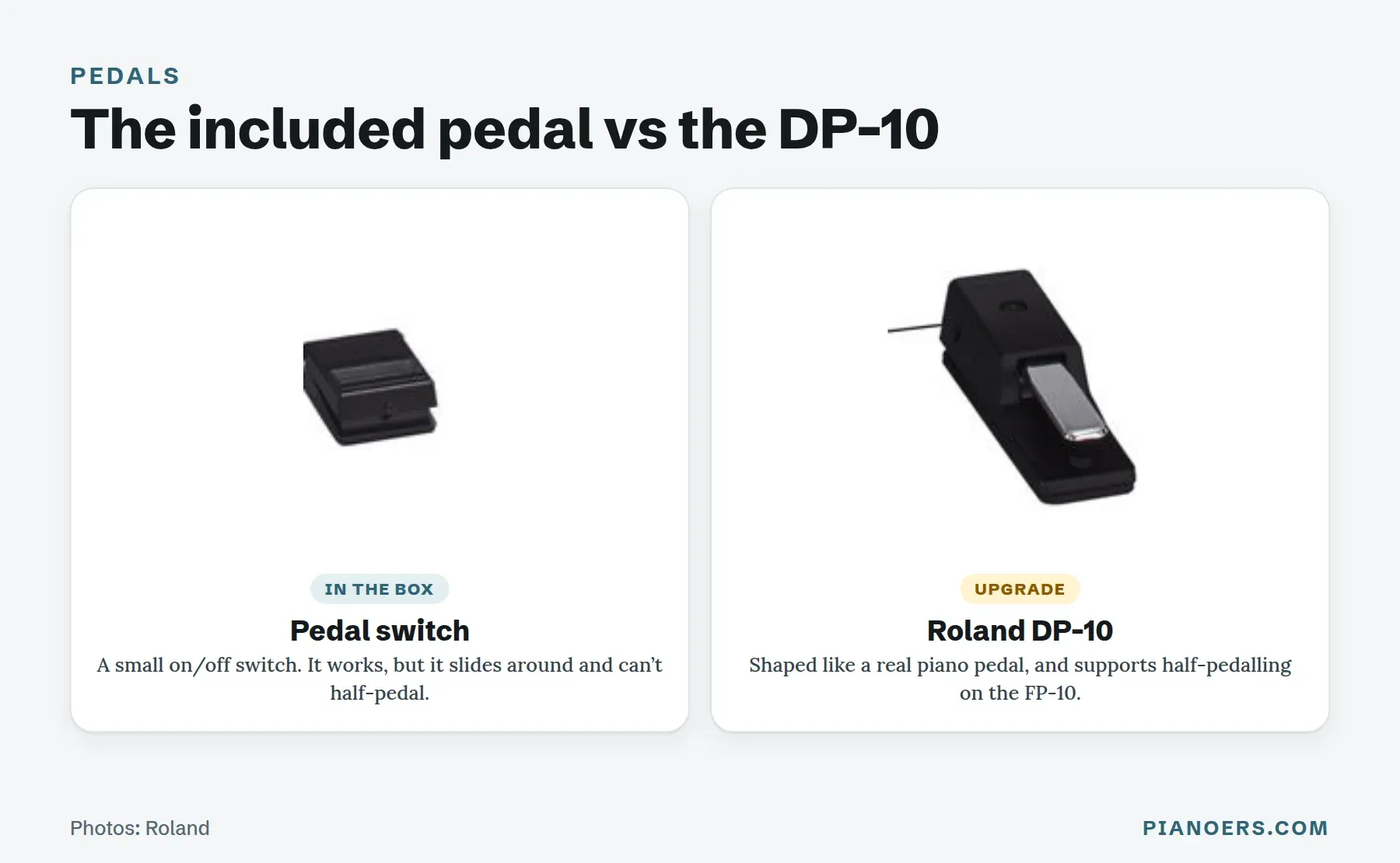
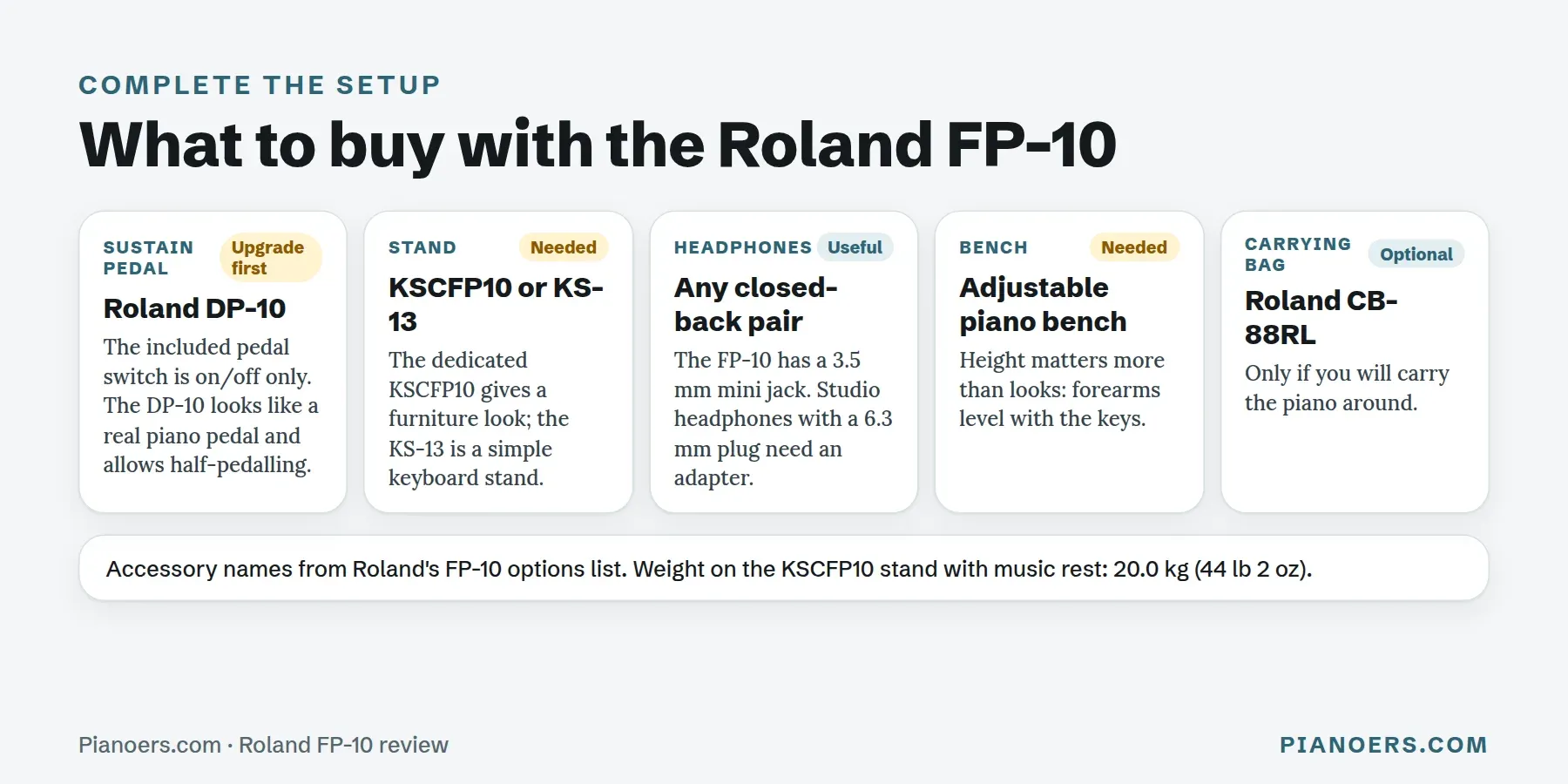
- Roland DP-10 pedal. Looks and feels like a real piano pedal and supports half-pedalling.
- A stand. Roland's dedicated KSCFP10 gives the FP-10 a furniture look (20.0 kg, or 44 lb 2 oz, all together); the KS-13 is a simple keyboard stand.
- Headphones with a 3.5 mm plug, or an adapter for 6.3 mm ones.
- An adjustable bench, so your forearms are level with the keys.
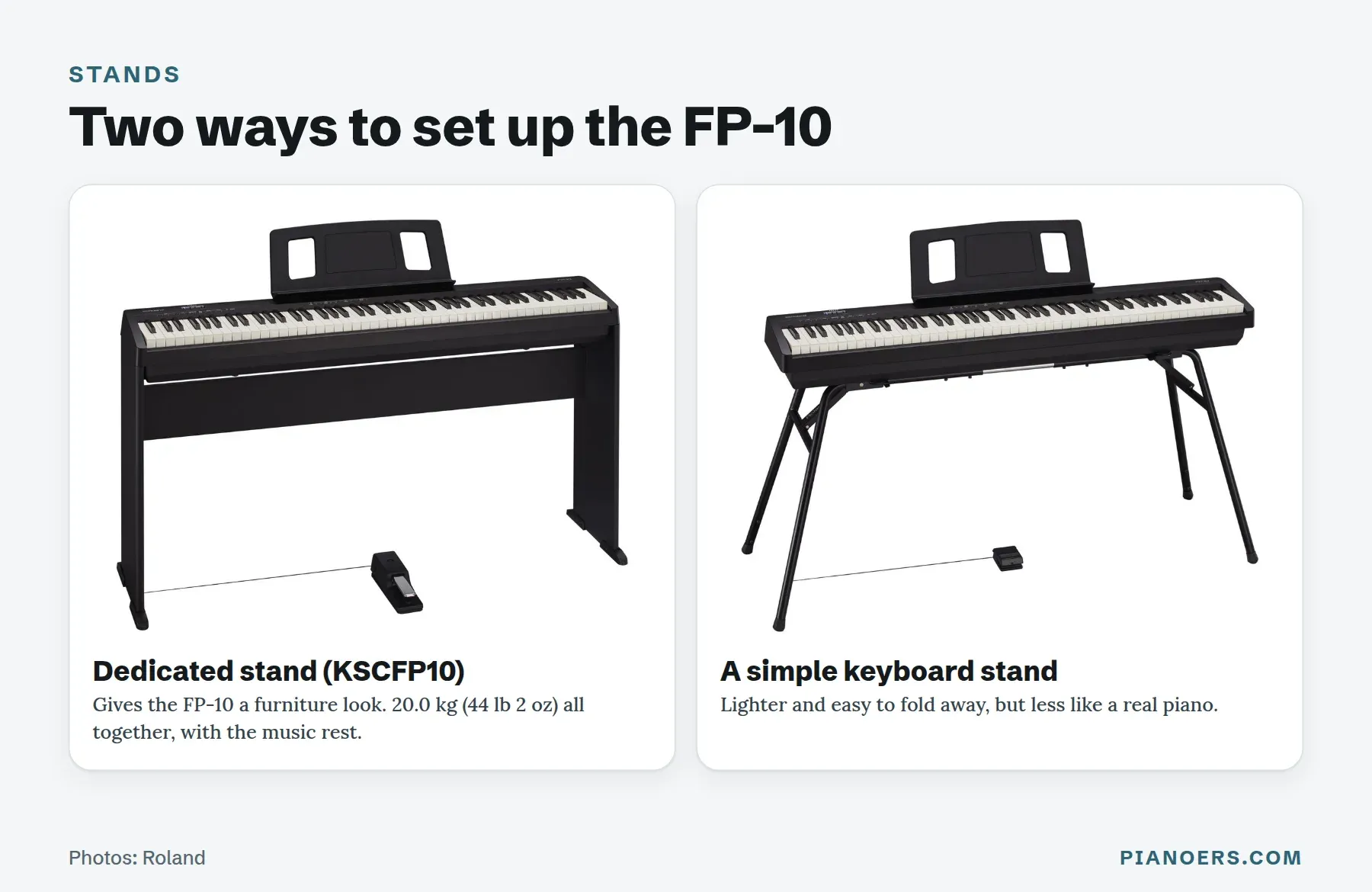
One limit: the FP-10 doesn't take a three-pedal unit. If you want soft, sostenuto and sustain pedals on a matching stand, look at the FP-30X.
Roland FP-10 vs Yamaha P-145
This is the comparison almost everyone makes, because they cost about the same. I own and use both, and they suit different people.
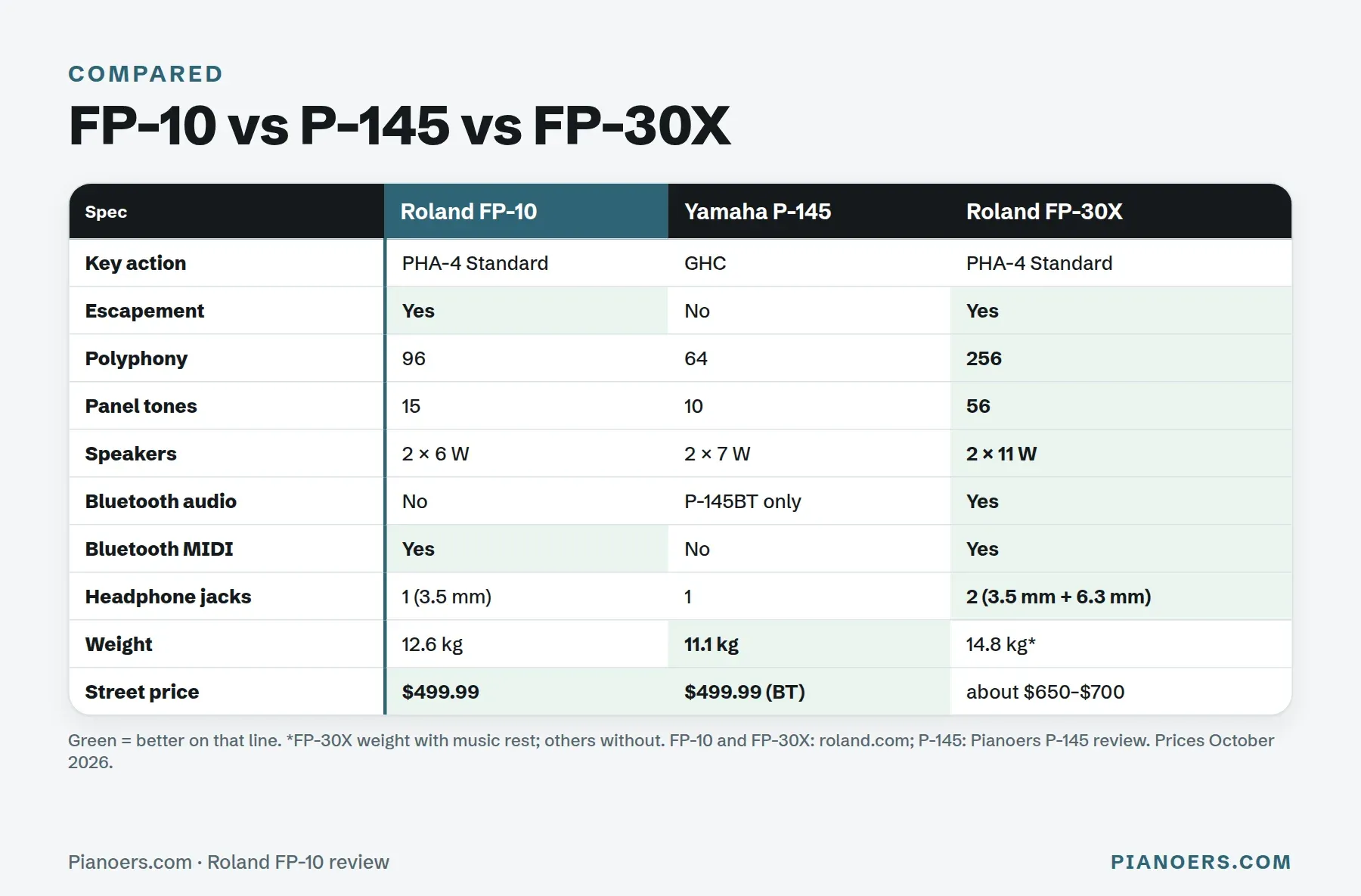
| Roland FP-10 | Yamaha P-145 / P-145BT | |
|---|---|---|
| Key action | PHA-4 Standard, with escapement | GHC (lighter and quieter) |
| Polyphony | 96 | 64 |
| Speakers | 2 × 6 W | 2 × 7 W |
| Bluetooth | MIDI (for apps) | Audio on the P-145BT (for music) |
| Weight | 12.6 kg | 11.1 kg |
| Price | $499.99 | $499.99 (P-145BT) |
- Choose the FP-10 if you want the more realistic, heavier key feel, more polyphony, and wireless MIDI for learning apps.
- Choose the P-145BT if you want lighter, quieter keys and want to stream music through the piano's speakers. My full take is in the Yamaha P-145 review.
Both are excellent first pianos. If you can, play both in a store: your hands will tell you within a minute.
Roland FP-10 vs FP-30X: is it worth stepping up?
The FP-30X has the same PHA-4 Standard keys, so the feel is identical. What the extra $150 to $200 buys you:
- Bigger speakers: 2 × 11 W instead of 2 × 6 W.
- Bluetooth audio as well as MIDI.
- 256-note polyphony and 56 panel tones.
- Two headphone jacks (3.5 mm and 6.3 mm) and proper output jacks.
- Support for a three-pedal unit.
If you'll mostly play through headphones, save the money and get the FP-10. If you want room-filling sound, play along with music, or want the full three-pedal look, the FP-30X is worth it. Both appear in my best beginner pianos guide.
Who should buy the Roland FP-10?
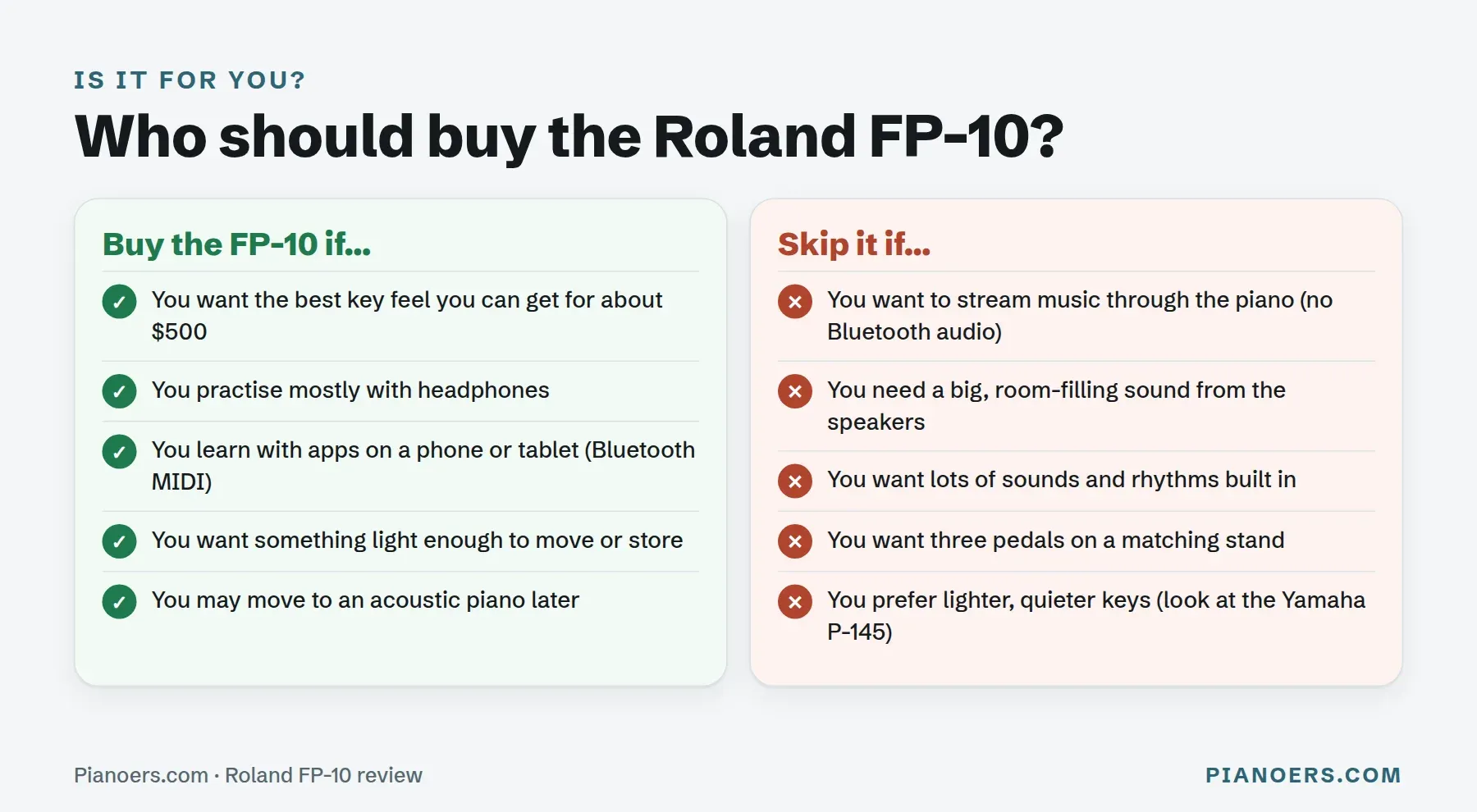
The FP-10 is perfect for beginners who are serious about learning properly, adults returning to the piano, students who will move to an acoustic piano later, and experienced players who want a light second piano. Roland itself calls it "the ideal second piano for more experienced players". It's less ideal if you want a do-everything keyboard with lots of sounds and rhythms, or big sound without headphones.
Still deciding between a digital and an acoustic piano? My acoustic vs digital piano guide walks through it.
Roland FP-10 pros and cons
Pros
- PHA-4 Standard action: escapement, ivory feel, graded weight
- The same keys as the FP-30X for less money
- Expressive SuperNATURAL Piano sound with resonance
- 96-note polyphony
- Bluetooth MIDI and USB MIDI for apps
- Twin Piano mode for lessons
- Compact and light: 12.6 kg
Cons
- Small 2 × 6 W speakers
- No Bluetooth audio
- One 3.5 mm headphone jack, no line out
- Only 15 tones on the panel
- Basic pedal switch included
- No three-pedal option
- Keys are heavier and a little noisier than the P-145's
Watch the FP-10 in action
Here's Roland's own FP-10 video, which shows off the sound and the keys:
My verdict
The Roland FP-10 does the one thing that matters most for a learner better than anything else at its price: it feels like a real piano. The PHA-4 Standard keys, with escapement and ivory feel, will build proper technique that transfers straight to an acoustic. The sound is expressive, and Bluetooth MIDI makes learning apps easy.
You give up big speakers, Bluetooth audio and fancy extras. For most beginners, that's the right trade. Add a DP-10 pedal and a good pair of headphones, and you have a setup that will last you for years.
My score: 4.3 out of 5. Best key feel under $500.
Check the Roland FP-10 price on Amazon
Want to compare it with other options? See the best beginner pianos and the best digital pianos at every level. And once it arrives, start with my piano basics guide.
Roland FP-10 FAQ
Is the Roland FP-10 good for beginners?
Yes. The Roland FP-10 is one of the best digital pianos for beginners because its PHA-4 Standard keys feel like a real piano and build proper technique. It costs about $500, has an expressive piano sound and connects to learning apps with Bluetooth MIDI.
Does the Roland FP-10 have weighted keys?
Yes. It has 88 fully weighted, graded keys with Roland's PHA-4 Standard action, including escapement and ivory-feel key tops. It's the same action as the more expensive Roland FP-30X.
Does the Roland FP-10 have Bluetooth?
Yes, but Bluetooth MIDI only. It connects wirelessly to apps like the Roland Piano App and GarageBand, but it can't play music from your phone through its speakers, because it has no Bluetooth audio.
Can you use headphones with the Roland FP-10?
Yes. It has one 3.5 mm stereo mini headphone jack, which also works as an output. Headphones with a larger 6.3 mm plug need a simple adapter.
Roland FP-10 or Yamaha P-145: which is better?
The FP-10 has the more realistic, heavier key action with escapement, 96-note polyphony and Bluetooth MIDI. The Yamaha P-145 has lighter, quieter keys, and the P-145BT adds Bluetooth audio. Both cost about $500; choose by how you want the keys to feel.
What's the difference between the Roland FP-10 and FP-30X?
They have the same PHA-4 Standard keys. The FP-30X adds bigger 2 × 11 W speakers, Bluetooth audio, 256-note polyphony, more tones, two headphone jacks, output jacks and support for a three-pedal unit, for about $150 to $200 more.
Does the Roland FP-10 come with a pedal?
Yes, a small on/off pedal switch. For a more realistic feel and half-pedalling, upgrade to Roland's DP-10 damper pedal.
How much does the Roland FP-10 weigh?
The FP-10 weighs 12.6 kg (27 lb 13 oz) without the music rest. On its dedicated KSCFP10 stand, with the music rest, it weighs 20.0 kg (44 lb 2 oz).
Can the Roland FP-10 use three pedals?
No. The FP-10 works with a single sustain pedal (the included switch or the DP-10). If you want three pedals, look at the Roland FP-30X.
Does the Roland FP-10 work with piano learning apps?
Yes, with apps that accept MIDI. You can connect over Bluetooth MIDI or a USB cable, depending on the app and your device. The free Roland Piano App works over Bluetooth and lets you change sounds and set the metronome.


Comments ()